Indeed…
Life Along the Orthodox Way


may wonder why I talk, write, sing, blog, and post so much related to Jesus. You need to know it’s not about you, as if I live on some higher plane, it’s about me.
I need a teacher, we all need a teacher but I do in particular. Life is hard, challenging, sometimes a complete mystery, and more often than not it pins the needle on the perplexing meter. I’m not the smartest person in the world on all of it. There are many who are wiser and better at this whole life thing than I am. Yet I think I’m smart enough to realize that I can’t do it all on my own.
I need not just smarts but real wisdom. I need not just knowledge but truth. I need to see not just the moment but the larger picture. Therefore I need a teacher, someone to stand outside of me and yet be intimately within my life. I need a teacher to keep my vision beyond the moment and to lovingly help me out when I get stuck, which is often. I need a teacher to correct me when I’m wrong, not for the sake of punishment but for my longer term good.
There’s a lot of false in this world, a lot of distractions, deep holes along the way, and blind alleys. I’d like to miss most of them if I could. So I need someone else’s eyes along the path and some kind of light when the darkness comes. What matters and what doesn’t? I don’t always know, so I’ll take as much outside help as I can. Life is precious, and short, so why not get all the stuff you need to live it well?
Among the other things that Jesus is to me, He is my teacher. This doesn’t mean I’m always the best pupil or that I remember all the lessons. Yet since we all have to have a teacher of some sort I believe I’ve got the best there is. So His words, His thoughts, His life, all of them are part of me and everything I do and try to be. Because of that whatever of Him that is in me also flows out of me and you’ll see it here and hopefully in my life as well.
And when the whole thing is done I’d like people to remember, first of all, that I tried to be a Christian. After that everything else, even the best of it, will find its own level.

in my clerical garb at St. George Antiochian Orthodox Church.


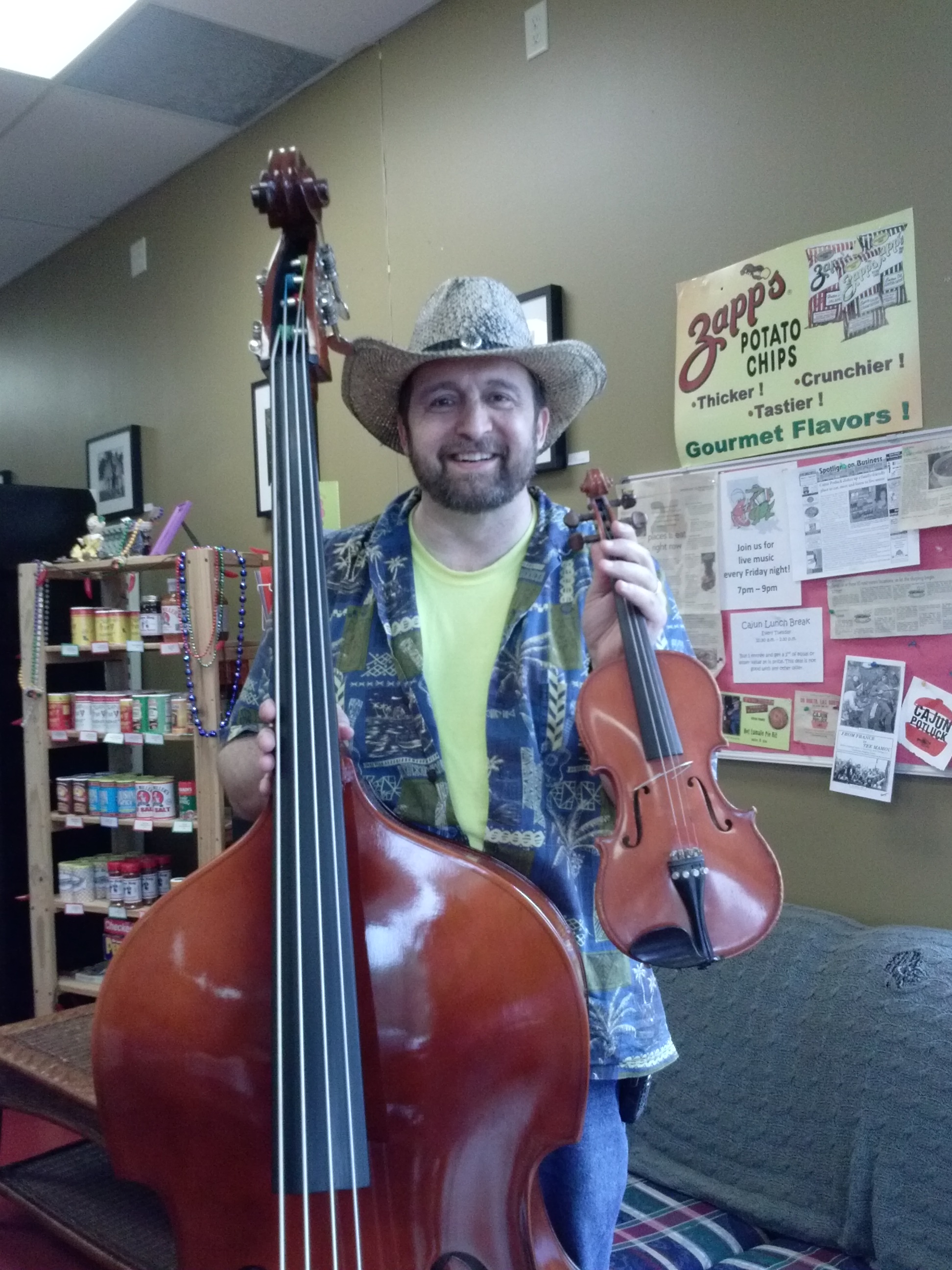
in my music related garb this morning at the Cajun Potluck Restaurant in Shoreview, Minnesota. Just thought you’d like to know.

The thing about holiness, though, is that the point of it is not to steer clear of all that is unholy; it’s not about retreating from “the world” and existing in some perfect space untainted by temptations and immoral sights and sounds. This only leads to legalism and a neutered, irrelevant witness.
Rather, the point of holiness is positive: to live in the world, reflecting Christ and his holiness outward in the way that we live our lives. Holiness is more complicated than just abstaining from a checklist of vices. Does holiness require us to avoid certain activities? Certainly. But fleeing from potential hazards is only part of the story.
Written from an Evangelical Christian perspective this article asks questions worth the consideration of Orthodox Christians as well. Read more here.

Today, to most Western couples the concept of merging two families sounds like a tribal ritual rather than a marriage blueprint. “In-laws, ugh,” this generation might say. By focusing on our personal preferences we get more wrapped up in what our future mother-in-law is going to wear or say at the wedding than in the bigger picture of what a wedding symbolizes: how you will coexist and interact with your new family for the rest of your life…
It’s no accident that the culture of catering to the bride has fueled the burgeoning wedding industry, and vice versa. Peggy Olson or Don Draper couldn’t have conceived a better marketing slogan than “This is your day”—the kind of tagline that so deeply, and reliably, influences consumer behavior. That simple phrase alone drives the billion-dollar wedding industry, pushing the cost of the average wedding in the U.S. in 2012 to $28,427, according to TheKnot.com…
Written from a Jewish perspective this article, and its take on the current marriage as a celebration of “me” and “us” is worth reading.

What a strange culture we live in, in which people are expected to approve of everything those they love believe in and do, or be guilty of betraying that love. I have friends and family whose core beliefs on politics, sexuality, religion, etc., are not the same as my own, and it would not occur to me in the slightest to love them any less because of it. I hope it would not occur to them to love me any less because they don’t agree with me. People are somehow more than the sum of their beliefs and actions.
Read more here.

St. Seraphim of Sarov describes the whole purpose of the Christian life as nothing more than the receiving of the Holy Spirit: “Prayer, fasting, vigils and all other Christian acts, however good they may be in themselves, certainly do not constitute the aim of our Christian life; they are but the indispensable means of attaining that aim. For the true aim of the Christian life is the acquisition of the Holy Spirit of God. As for fasts, vigils, prayer and almsgiving, and other good works done in the name of Christ, they are only the means of acquiring the Holy Spirit of God… Prayer is always possible for everyone, rich and poor, noble and simple, strong and weak, healthy and suffering, righteous and sinful. Great is the power of prayer; most of all does it bring the Spirit of God and easiest of all is it to exercise.”



 The Beautiful Path