Indeed…

The difference between Christians and the rest of men is neither in country, nor in language, nor in customs…. They dwell in their own fatherlands, but as temporary inhabitants. They take part in all things as citizens, while enduring the hardships of foreigners. Every foreign place is their fatherland, and every fatherland is to them a foreign place. Like all others, they marry and beget children; but they do not expose their offspring. Their board they set for all, but not their bed. Their lot is cast in the flesh; but they do not live for the flesh. They pass their time on earth; but their citizenship is in heaven. They obey the established laws, and their private lives they surpass the laws.

“Letter to Diognetus” c 125/200 AD

Via Bishop Melchisedek

Wise Thoughts…

“The majority of modern thought exalts the state at the expense of the family, treating the family as a problem that has to be redefined continually and managed by the benevolent bureaucrats of the more powerful and wiser state. But the experience of politically and economically turbulent times reveals that the family is, and must remain, the more fundamental entity. A man “cannot really refer the daily domestic problems of his life to a State that may be turned upside-down every twenty-four hours. He must, in fact, fall back on that primal and prehistoric institution; the fact that he has a mate and they have a child; and the three must get on together somehow, under whatever law or lawlessness they are supposed to be living.” — G.K. Chesterton.

A Good Word…

Wherefore, though good and bad men suffer alike, we must not suppose that there is no difference between the men themselves, because there is no difference in what they both suffer. For even in the likeness of the sufferings, there remains an unlikeness in the sufferers; and though exposed to the same anguish, virtue and vice are not the same thing. For as the same fire causes gold to glow brightly, and chaff to smoke; and under the same flail the straw is beaten small, while the grain is cleansed; and as the lees are not mixed with the oil, though squeezed out of the vat by the same pressure, so the same violence of affliction proves, purges, clarifies the good, but damns, ruins, exterminates the wicked. And thus it is that in the same affliction the wicked detest God and blaspheme, while the good pray and praise. So material a difference does it make, not what ills are suffered, but what kind of man suffers them. For, stirred up with the same movement, mud exhales a horrible stench, and ointment emits a fragrant odor.

St. Augustine of Hippo

via the Holy Fathers Facebook Page

An Old Friend Visits…

Had a return visit from my old friend, atrial fibrillation, last night. I say “old friend” with a bit of sarcasm yet it also is an old friend in the sense that, while it’s not fatal, feeling your heart go bump in the night does help you sort out the things that matter from those that don’t. Even illness can be a source of blessing for those who let the weakness and struggle draw them away from the things that mean little and towards the things, and the One, that endure.

Of course I wish it was different and I wish it would go away. It’s hard to feel your heart struggle to get back into a normal rhythm. Yet I was born in God’s care, I live my life in God’s care, and I will pass into eternity in God’s care. One day, if the Lord tarries, my body will be a thin line in the ground, earth to earth awaiting the resurrection. So it should be no surprise when, even now, it manifests some of its struggles that will eventually, but temporarily as Christians know, cease its earthly journey.

Until then I plan on living a life as close to the coming eternity as possible and my prayer is that things that, like my heart, sometimes go bump in the night will not draw my away from the narrow but beautiful path. Your prayers would be appreciated as well.

On Why…

the people on Icons look “weird”…

The way people are depicted in icons is, on the one hand, visibly decipherable as being completely human and like us. Yet on the other hand, iconographic, artistic flair portrays these dead-but-not-dead people in an abstracted, stylized way that proclaims in a poem for the eye that these people are in heaven. For an artist to paint a portrait of someone who is dead-but-not-dead presents a formidable challenge. The answer is revealed as being that “weird” look expressed in Orthodox iconography. –

See more at: http://www.soundingblog.com/index.php/art-literature/iconography/dead-people-and-why-icons-look-weird.html#sthash.T2DeUBX0.dpuf

St. Kyriaki…

Among the most steadfast of all the Saints are the virgin martyrs. Their fortitude in the face of extreme persecution humbles us who are often only mildly inconvenienced, at worst, for Christ.  Oh, to have this kind of love for Christ and this level of faith. St. Kyriaki pray for us.

st-kyriaki

Blinged out Weddings…

…I’ve since learned that planning a truly simple wedding has become practically impossible, unless couples elope or really buck all traditions. Recklessly extravagant weddings have become a cultural expectation. And brides who succumb to the intense pressure to Go Bigger can easily find themselves focused more on planning a wedding than preparing for a marriage.

Read more here.

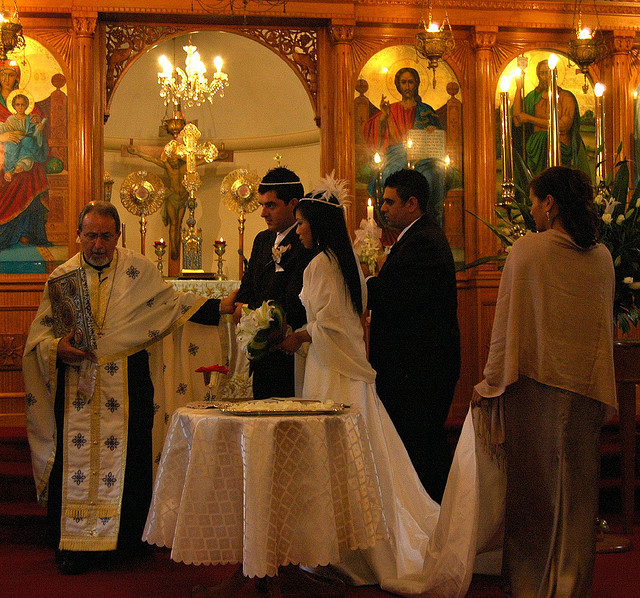
It is possible, easily possible, in the Orthodox Christian context, to have a beautiful and simple wedding. In fact one of the great blessings of Orthodox Christian Faith is that such things, guided by centuries of wisdom and practice, actually are simpler and more beautiful than having to create an “experience” from scratch.


orthodox wedding


So How Do We…

live and share our message without becoming this…

Campaigns designed to raise awareness are as much about advertising the status of the campaigners as they are about changing the outlook of a target audience. For example, advocates of breastfeeding produce literature that affirms the virtuous nature of their own lifestyles while also inviting those who have not seen the light to become aware. The very term ‘raising awareness’ involves drawing a distinction between those who are enlightened, who are aware of something, and those who are not. It draws attention to the fundamental contrast between those who know and those who are ignorant, between the morally superior and the morally inferior. So someone who allows his children to eat junk food is not only unaware and ignorant; he’s also morally questionable.