Among the Challenges…

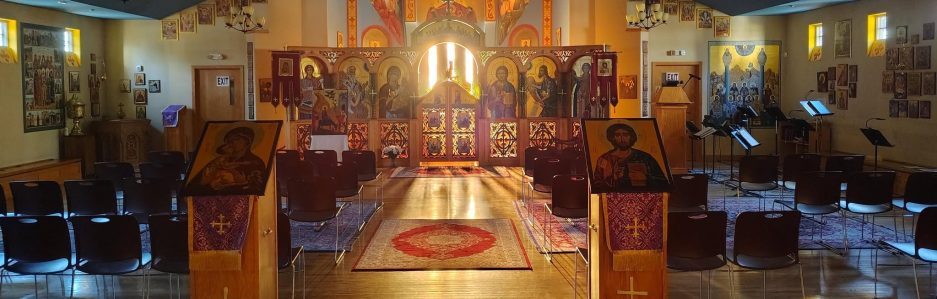
we face in Orthodoxy here in the United States is the idea that infrastructure is the goal and end of the mission of the church and not the servant of that mission. We pride ourselves on beautiful temples that are used a few times a week at best and spacious offices, halls, and classrooms, that mostly sit empty. That we possess such things is  too often considered a sign of the health and wealth of a parish and often the clergy of a parish are judged by their skill in growing and maintaining infrastructure.

The problem with this is that we are not called by Christ to build infrastructure so much as we are called to build a Kingdom. How many of our parishes are actually hobbled in the building of this Kingdom because time, money, and resources are expended in the care and feeding of infrastructure over and against doing the things that Christ actually asks us to do? How many poor are not fed? How many prisoners remain unvisited? How many sick are not tended to? How many places is the good news of Christ not heard? All because we’re so busy keep largely empty spaces funded and intact?

One of the ways a parish can measure its actual, as against perceived, impact in a community is to ask a simple question. “If our parish were to close tomorrow who, besides the members, would miss it?” In answering that question a parish can discover whether they are simply a group of people with nice facilities or a meaningful part of the movement that is the Kingdom of God, active and alive in the world around them. This can also be sobering because for many of our parishes the unclouded, truthful, answer will be “We’ve got a lot of nice things but we really don’t mean much to anyone outside our doors.”

The hard truth, though, can be very liberating as well. When parishes see themselves not as institutions whose energy is directed towards maintaining that institution’s infrastructure but rather as a mission station of the larger movement that is the Kingdom of God they can see all they have, and there’s nothing wrong with having resources per se, in its proper context. Crucial, powerful, dynamic, and wonderful changes can happen when a parish says “How do we use what we have to reach out to the world? How do we channel our resources to do what God wants us to do?”

In the case of buildings we need to ask “How can we sanctify all this space for the advancement of the Kingdom of God and the blessing of the world around us?” In the case of programs and resources we need to shift them away from maintenance for its own sake into growth, charity, and the advancement of the Gospel. In doing this our infrastructure becomes not an end in itself but a powerful tool for the glory of God and a servant of the actual mission of the Church. And as we do this we may discover a joy, passion, meaning, and life in our Faith that we thought had long disappeared.


A Prayer…

Prayer at Daybreak

Eternal King without beginning, You who are before all worlds, my Maker, Who have summoned all things from non-being into this life: bless this day that You, in Your inscrutable goodness, give to me. By the power of Your blessing enable me at all times in this coming day to speak and act for You, to Your glory, in Your fear, according to Your will, with a pure spirit, with humility, patience, love, gentleness, peace, courage, wisdom and prayer, aware everywhere of Your presence.

Yes, Lord, in Your immense mercy, lead me by Your Holy Spirit into every good work and word, and grant me to walk all my life long in Your sight without stumbling, according to Your righteousness that You have revealed to us, that I may not add to my transgressions.

O Lord, great in mercy, spare me who am perishing in wickedness; do not hide Your face from me. And when my perverted will would lead me down other paths, do not forsake me, my Savior, but force me back to Your holy path.

O You Who are good, to Whom all hearts are open, You know my poverty and my foolishness, my blindness and my uselessness, but the sufferings of my soul are also before You. Wherefore I beseech You: hear me in my affliction and fill me with Your strength from above. Raise me up who am paralyzed with sin, and deliver me who am enslaved to the passions. Heal me from every hidden wound. Purify me from all taint of flesh and spirit. Preserve me from every inward and outward impulse that is unpleasing in Your sight and hurtful to my brother.

I beseech You: establish me in the path of Your commandments and to my last breath do not let me stray from the light of Your ordinances, so that Your commandments may become the sole law of my being in this life and in all eternity.

O God, my God, I plead with You for many and great things: do not disregard me. Do not cast me away from Your presence because of my presumption and boldness, but by the power of Your love lead me in the path of Your will. Grant me to love You as You have commanded, with all my heart, and with all my soul, and with all my mind, and with all my strength: with my whole being. For You alone are the holy protection and all-powerful defender of my life, and to You I ascribe glory and offer my prayer.

Grant me to know Your truth before I depart this life. Maintain my life in this world until I may offer You true repentance. Do not take me away in the midst of my days, and when You are pleased to bring my life to an end, forewarn me of my death, so that I may prepare my soul to come before You.

Be with me then, O Lord, on my great and sacred day, and grant me the joy of Your salvation. Cleanse me from manifest and secret sins, from all iniquity hidden in me; and give me a right answer before Your dread judgment-seat.

The World We Live In…

is not the real world. Don’t get me wrong, its not an illusion its just not the world as God intends it. There is a brokenness in it that has distorted it from its original design, purpose, and reality and so there is a kind of unreality, a sense of it being skewed, that permeates it. There are markers of the real world in this world but the fullness seems always just out of our grasp.

The Kingdom of God is the real world, the world as it should be, a world restored to its design, purpose, and destiny by the One who created it in the first place. It is also real and can be experienced in time. The difference between the Kingdom of God and the world we experience is that the Kingdom of God, its values, its Faith, its vision, embody the fullness of what God intends and the fullness of what it means to be a human.

This creates a tension for the observant Christian. We live in a world that has an unreality to it because it is good, because it was created by God, but broken because it is tarnished by human sin and mortality. We experience this brokenness in so many ways and the power of it can often be overwhelming. Even if we are truly convinced there is more and better that more and better can seem far away and extraordinarily difficult to achieve. We also live in a another world, as it is, a world we call the Kingdom of God the reality of which sometimes intersects the world we experience every day but also has the potential to alienate us from it as well.

The result is that we are travelers in time. We live in places and share the common lot of those who share this time and place with us yet we also know that even in its best moments our experience is touched with the sadness, sin, and death that has been horribly inserted into this realm. And its hard to live that way, caught between two worlds, the world we were born into and the world we called to. Choices have to be made. Loyalties need to be discerned. Where, in the end, do we belong? To what world will our final allegiance be given? Jesus was so right when He said our heart would be where our treasure is.

In these times, when the veneer of respect for our Faith is rapidly wearing off in the public arena, where the times are growing dark as people in greater numbers seem to have cast their lot with this world, and where even people who were entered the Kingdom are now looking over their shoulders at the world they left behind, we will all be tested. What realm can lay claim to our true citizenship? What storehouse holds our true treasure? Which world’s thoughts will become our thoughts? And the stakes may be eternal.

The answer? All I know to do is to stay as close as possible to Jesus and together we’ll ride out the storm and make it safely home.

10 Things Orthodox Christians Would Like You to Know

10 Things Orthodox Christians Would Like You to Know  by Dn. Charles Joiner

1) We don’t worship Mary.  We hold her in a place of esteem because of her singularly unique role as the birthgiver of Jesus Christ.  Orthodox Christians state and affirm over and over again throughout the worship services that God alone is the only One to Whom worship is due.
2) We don’t worship icons.  Icons are like a family photo album.  Just as in our own families, where we keep the pictures of our loved ones who have departed this life on shelves and hanging on walls, we also keep the pictures of the members of our larger Christian family around, particularly those members of our Christian family who have led exempliary lives.  The word icon only means “image” or “picture”.
3) When we talk about tradition, we don’t mean the traditions of men, we mean Holy Tradition.  The traditions that the Church has taught have always been those that have been led by the Spirit.  It was the tradition of the Church that gave us the New Testament and, the New Testament also continues to inform that traditon.  It is cyclical and not mutually exclusive.
4) Orthodox Christianity is not “works” based.  It always takes the grace and will of God to bring about our salvation.  We do good works because it is the outpouring of the joy that we experience through living Christ-centered lives and because it is an expression of righteous living and of love for God and neighbor.  There are no “points” earned by doing good works.
5) There’s no such thing as the Byzantine Empire.  This was a term invented by French scholars retroactively during the rennaisance.  Constantine moved the capital of the empire to the east and Constantinople became known as New Rome.  Though portions of the Western half of the Roman Empire fell, the Eastern half continued for over a thousand years after the Goths sacked Rome.  Those living in the Eastern part of the Roman Empire did not think of themselves as “Byzantines” or even Greeks.  They were Romans.  Even today, the Turks still refer to Orthodox Christians living in Turkey as “Roman”.
6) “True” Christianity did not disappear when the Church received legal recognition from the Roman Government.  Faithful, pious and righteous Christians continued to live in faith and suffer martyrdom and persecution.  The Church thatwas founded by Jesus Christ, and its theology, remained intact.  Those who became frustrated with government intervention in Church life struggled to maintain the purity of the church’sdoctrine and life.  However, since the Church continued to adhere to its basic teachings without dilution, it was necessary for pious believers to continue their struggle within the church.  It was believed that no person had the right to create or invent his or her own church.  It is also significant to mention that the Orthodox Church continues to bear much fruit.  If losing one’s life, or martyrdom, is the ultimate expression of one’s devotion to Christ, there has never been a more fruitful time within the Church.  There were more Christian martyrs in the 20th century than all previous centuries of Christian history combined.  Most of these martyrs were Orthodox Christians who refused to renounce their faith.
7) The Orthodox Church is not a denomination nor is it “non-denominational”.  It is pre-denominational.  The Church was without break or separation for more than 1,000 years.  The Orthodox Church did not break away from any other group.  The Orthodox Church continued right along up to this day.  In fact,groups that refer to themselves as “non-denominational” because they are free standing churches, not connected with any larger mainline protestant confessions, are, in fact, denominations.  Since a denomination means a breaking down of the whole or a separation, they are simply denominations consisting of one parish.
8) Yes, the Orthodox are “Bible believing” Christians.  Almost everything within Orthodox worship comes directly from the Bible, both Old and New Testaments.  There is probably more Bible read on a single Sunday Morning in Orthodox Worship than in an entire year in most other churches.  (Editor’s note: This may be an exaggeration but the point is still valid, there is a lot of Bible in Orthodox worship)
9) Orthodox Christianity is not an exotic form of Roman Catholicism.  While both Churches have organized worship, the life, practice and doctrine of the Roman Catholics and The Orthodox are quite different.  The Orthodox view the Pope as the bishop of Rome, not a supreme leader of the entire Church.  And, because, in the eyes of the Orthodox, the Pope has stated that his authority is over the entire Church, The Orthodox are not currently in communion with Rome.  Roman Catholic doctrinal principles such as the Immaculate Conception of Mary, Papal Infallibility, Transubstantiation of Holy Communion, and Original Sin are absent from the Orthodox Church.  These perspectives took root in the Roman Catholic Church after East and West went their separate ways.
10) Jesus Christ, our Lord and Savior, is the head of the Orthodox Church: not Luther, not Calvin, not Wesley.  The Orthodox Church can trace the lineage of the ordinations of its clergy all the way back to Christ Himself with unbroken continuity.  Orthodox Christianity has remained faithful to Christ not only doctrinally but also historically.
With these things said, The Orthodox are not trying to convert you. (Editor’s note: We do believe in conversion and mission and engage in ongoing efforts but the 20th century Protestant programs of mass evangelism may not be suitable for Orthodox Faith which is more of a lived experience than a single moment of decision.)  We believe in tolerance (respect) of other faiths, and this has been written so that those of you who may come from other backgrounds might be more tolerant of us.  Please don’t write us off.  Learn what we really think, do and believe before deciding without sufficient knowledge.  We’re believers.  We don’t preach false doctrine.  We accept the Bible as the Word of God.  Simply put, we struggle within the boundaries of the church to always be as good of an expression of the Kingdom of God on earth as possible.  This is because Christ created one Church and prayed that It would remain one.  We believe it is our sacred duty to preserve this oneness.  We are not allowed to whimsically create a new church whenever we are upset.  If we don’t like what’s happening in our Church, we don’t leave.  We risk persecution, even to death, to protect the faith because that’s what Christ did when He created The Church.

While Most of the Western Powers…

have either given up or are loosening the grip on their territorial colonies the urge to colonize, to walk into another person’s world with instructions for right living and social order and then use means to establish such an order appears to have continued unabated. This time the forum is culture.

My own country is an example. Along with military presence perhaps the greatest single export of the United States is in the world of ideas and culture. Gone are the days, of course, where prim American missionaries would go around the world telling people in hot climates to dress like they do in Boston or they won’t actually be Christians. Now the new American missionary produces television shows, commercial products, multinational companies, and whatever culture that comes in the package with them.

Increasingly and sadly that culture is often rotten, a sick mix of violence, promiscuity, and consumption for its own sake. We have found a way to export our consumer goods and the emptiness of soul that comes in the same box. We have a veneer of charity but the people receiving it know that its the overflow of our excess. We have become evangelists every bit and more enthusiastic than those who brought Bibles for an anti- gospel, if you will, that is less enlightening, a message of power, greed, promiscuity, and a life given over to acquisition.

And when the people we send these things to are hesitant to embrace them our vaunted tolerance and diversity turns into a snarl. Witness the cultural belittling of Russia simply because they don’t wish to have teachers in their grade schools showing children how to put condoms on bananas and exploring anal sex in their early teens. The barbarians must embrace the new religion or be taught a lesson. Witness how our aid is distributed to the poor and needy throughout the world on condition that they embrace the instructions that come with it or risk having that aid be removed. Witness, as well, that when people refuse to embrace this way of life we propose we strive to shut down their economies or send our drones to enforce our will through death.

Who is the culture killing, soul deadening colonial missionary of this day? It is certainly not the man or woman with a heart for God and a desire to build a health clinic in a place of poverty. I would suggest, instead, that the true colonialists of our time often wear business suits and come with technological baubles in hand that catch the eye but have strings, even chains, attached. They are emissaries of a “modern” world whose technological benefits are quickly being overcome by its moral and spiritual emptiness.  What good is a television that spews social filth or an industrial base that produces temporary junk made by disposable people?

Thus the resistance. People around the world have television and the internet. They see not just the trappings of who we are but the reality that often underscores it as well. They see the tragedy behind the glittering lights. They understand the emptiness behind the manicured smiles. And they want very little of it. Pure water, constant electricity, advanced medicine, absolutely. Mindless consumption, moral drift, women who twerk and men who enjoy watching them, not so much.

And its in our best interest to let them be exactly who they want to be. You see, some day when our emptiness makes its full run, when the measure of our pride and sin is full, and when the mirage of the world we’ve created melts back into the desert of reality we’ll need those people who were wise enough not to buy everything we were selling. If God is merciful to our cries they will come to us and teach us how to be human again.

Saints and Sinners…

Understand two thoughts, and fear them. One says, “You are a saint,” the other, “You won’t be saved.” Both of these thoughts are from the enemy, and there is no truth in them. But think this way: I am a great sinner, but the Lord is merciful. He loves people very much, and He will forgive my sins.

– St. Silouan the Athonite

Via the OCA Bulgarian Diocese Facebook Page

Sin and Forgiveness…

When St. Amphilochios was asked how to avoid despair over reoccurring sin, he answered with the following account:

“A certain brother, overcome by the passion of immorality, sinned every day. However, each time, with tears and prayers, he would fall before Christ and receive forgiveness from Him. And as soon as he had repented, the next day, being misled again by shameful habit, he would fall to sin again.

After having sinned, he would go to the Church, prostrate himself before the Icon of our Lord Jesus Christ and tearfully confess: “Lord, have mercy upon me and takeaway from me this fearful temptation, for it troubles me fiercely and wounds me with the bitter taste of pleasure. O my Master, cleanse my person once more, that my heart might be sweetened and thankful. My Lord, on my word, I will no longer commit this sin.”

And though his lips had just whispered these words, no sooner would he leave the Church than he would fall once again to sin. This happened not for one or two or even three years, but for more than ten years.

One day when all that we have described again occurred, the brother, having fallen to sin, rushed to the Church, lamenting, groaning, and crying with anguish, to invoke the mercy of God, that He might have compassion on him and take him from the sin of immorality.

No sooner had he called on God, the lover of man, than the Devil, that destroyer of our souls, seeing that he could gain nothing, since whatever he accomplished by sin, the brother undid by his repentance, became infuriated and appeared visibly before the brother. Facing the Icon of Christ, the Devil said to our compassionate Savior: “What will become of the two of us, Jesus Christ? Your sympathy for this sinner defeats me and takes the ground I have gained, since you keep accepting this dissolute man and prodigal who daily mocks you and scorns your authority. Indeed, why is it that you do not burn him up, but, rather, tolerate and put up with him? To this fellow here, even though an immoral man and a prodigal, you calmly show your sympathy, just because he throws himself down in front of your Icon. In what way can you be called a just Judge, then? The Devil said all of this, poisoned with great bitterness, while there poured forth from his nostrils a black flame.

Having said these things, he fell silent and a voice from the sanctuary answered him, “O, all-cunning and ruinous Dragon, are you yet not satisfied with   and destructive desire to gobble up the world? Now you have even the nerve to try to do away with this man here, who has come with contrition to entreat the mercy of my compassion to devour him, too? Can you offer up enough sins that, by them, you can tilt the balance of justice against the precious blood which I shed on the Cross for this man? Behold my murder and death, which I endured for the forgiveness of his sins.

“You, when he turns again to sin, do not turn him away, but receive him with joy, neither chastising him nor preventing him from committing sin, out of the hope that you might win him over; but should I, who [taught my disciples] to forgive sins seven times seventy (Matthew 18:22), not show him mercy and compassion? Indeed, simply because he flees to me, I will not turn him away until I have won him over. I neither turn away nor reject anyone, even if he should fall many times a day and many times return to me; such a person will not leave my Temple saddened, for I came not to call the righteous, but to call sinners to repent. Look at this man who a few moments ago repented, having returned from sin and having fallen at my feet with a sincere resolution to abandon sin, has thereby conquered you.”

While [all of] this was being said, the repentant brother had thrown himself before the Icon of the Savior. With his face to the ground and lamenting, he surrendered his spirit to the Lord. From this incident, my brothers, let us learn of the limitless compassion of God and of His love of man, that we might never again be disheartened by our sins, but rather look after our salvation with zeal.”

Via the Facebook Page of Fr. Thaddeus Hardenbrook