Spent the weekend driving up and down the hills around LaCrosse doing house blessings and surviving, by God’s grace, the cold temps. Right now (Monday morning) its warmed up to a balmy -15 below farenheit.
Ironic, isn’t it that just after a group of scientists sponsored by the UN talk about global warming large sections of the US, and I’ve heard Russia as well, go very cold. A part of me is cynical when all these studies come out. I’ve long ago disabused myself of the notion that scientists are impartial and apolitical sorts who only seek the truth provided by empiricism. Quite frankly, large swathes of the academic world lean to the political left, incestuously relate to each other, and vigorously enforce thier orthodoxies. A Phd in climatological studies means absolutely zero outside of the small world of academics so toe the line or take your degree to McDonalds.
And do you really trust the UN to get anything right?
Some of us who are a little older remember the panic in the seventies about the coming “global ice age.” Those who are a little older yet remember the hysteria about the “population bomb” and how the world would soon be overrun by billions of people and we’d all be reduced to eating grass in a global desert. Various other scientists have predicted all sorts of doomsday scenarios with the fervor of Hal Lindsey all of which have the fact they were wrong in common.
The Psalmist told us long ago to not put our trust in princes or in the sons of men because all humans are fleeting and all our ambitions and fears die with us. We know, as well, that all history is in God’s hands as is the very creation itself. So we need not give in to panic, and should face all attempts to create the same whether they come from crazed preachers, politicians seeking power, or scientists caught up in academic fads, with discernment and without fear. Our faith gives us perspective and allows us to stand back from the ever changing winds of time and see the world in a remarkably different, even eternal way.
As Christians we’ve always known we are caretakers, and not owners of creation. Our faith tells us to exist without extravagance, share our wealth, and live with a minimum impact on what God has made for our sustenance and pleasure. So we need no one to panic us to live with an eye on conservation and care for the Earth. In fact, Christian faith is very much more attuned to the rythm of season and time and nature then much of what science has developed, as helpful as that can be, and if the world needs an ecological handbook they might just try dusting off that Bible in the library.
So who knows what the weather will be like next year? The truth is no one for sure. But come what storms or pleasant breezes our trust in God will carry us through. And to the extent we practice the care of creation in the fullness of the Christian tradition we will always be the gardener priests we were meant to be and our blue island in the depths of space will be preserved.

This week's sermon in advance…
Sunday of the Prodigal Son
February 4, 2007
Homily
February 4, 2007
Homily
What does it mean to forgive?
I still struggle with that at times, and I suspect that most of us do as well. We struggle with what the word means, what it calls us to do, and how it changes our lives.
And many of us have vey little knowledge of what forgiveness entails especially when the wounds are deep and the harm catastrophic. Well meaning people talk about “just letting it go” or “moving on” but sometimes its not as simple as that. When we were kids and got into a fight the teacher would make us stop and shake hands but in this broken world people sometimes do great damage and sometimes not by accident yet still we are called to forgive. Many will spend their whole lives learning to forgive.
In our Gospel today we have an example of forgiveness, of a father grieviously wronged by a shallow and selfish son. When this son comes on desperate times he realizes the error of his ways and seeks to return home. A stumbling apology comes out of his mouth, the brokenness pouring from him. Even as he speaks his father embraces him, removes the ragged clothes, and celebrates a feast of joy at his return.
What isn’t in the story is how the father came to the place where he endured the hurt, worked through the insult and the pain, and came to be at a place in his life when the return of the very one who had caused such harm could bring joy.
But the Scriptures give us a clue about how this happens.
We know that Jesus told His disciples they should pray to be forgiven as they forgive those who trespassed against the. Sometimes we pray that prayer so casually that we can say it and read a book at the same time, but from it we understand that our own forgiveness is tied to the forgiveness we give others. A sobering thought.
We know that when someone wrongs us they incur a debt to us and that forgiveness is our releasing of that obligation. The sins we all do are not only against God but also each other and when we have wronged we have a moral obligation to make it right and when those who have wronged us seek forgiveness we have a moral obligation to release them.
The Bible teaches us that forgiveness doesn’t mean the wrong that was done never happened or that consequences won’t remain. The prophet and king David was truly forgiven of his rape of Bathsheba and the murder of her husband but the repercussions of it haunted his whole life.
We see numerous examples in the Scripture of the bitterness and pain that was brought into the life of those who held grudges, who clung to the wrongs done to them, and acted in vengeance.
The Scriptures also teach us that forgiveness sometimes takes time. St. Peter asked Jesus “How many times should I forgive a brother who sins against me? And Jesus answer of seventy times seven meant more than just 490 but rather implied that forgiveness may need to be repeated until it takes hold, until the fulness of it has come to pass.
Above all the Scriptures and the Tradition of our Church teach us that forgiveness is among the most prized of virtues. It marks a Christian life, and when practiced brings healing to both the one wronged and the one who offended.
So how are we to become people of forgiveness, people who model God’s own loving forgiveness and in turn receive forgiveness for themselves?
First we must determine in our will that forgiveness will be a part of our life, a value we hold, an act we practice, and a skill we develop. In the same way we grow in all the graces of the Christian life through study, prayer, and practice we should grow in forgiveness as we mature in Christ.
Along with this we must also develop the grace to be a person not easily offended. Sometimes we are full of pride or self justification, quick to take offense, hyper-sensitive, unwilling to listen, and too ready to pick at each other for no good reason. How quickly we look for words that we can single out, or actions for which we can demand redress. How often we desire to score points against another to claim some kind of victory. How many years go by while we still hold grudges often for no good reason at all. A gentle spirit, slow to take offense and slower still to take vengeance is a spirit where forgiveness exists even before the wrongs that may draw on its graces.
But sometimes the wrongs are profound and the wounds authentic and deep and still we must forgive. In these times we come to see that forgiveness is more than an event but rather its a process, an attitude of the heart, a commitment of the will, and a state of the soul. We may need to revisit a deep wrong against us many times, weep over it many times, experiences its pain again and again as we slowly give it to God and purge it from our lives.
We come to terms over time with the reality that our life has changed and that we’ve been damaged. We take care to protect ourselves. Yet there is also a part of us that sees a greater reality that begins to transform what has happened to us. The outworking of God’s grace, even if it takes a lifetime, produces in us both the grace of our own recovery and the hope of the transformation and salvation even of the one who has done us harm. As long as this lives inside of us we are granting forgiveness in a way similar to God and ensure our own forgiveness as well.
Perhaps in this coming Lent the task that will be laid before you will be the challenge of forgiveness. For too long you’ve held on to wrongs done to you or were too quick to imply wrong in others. Somewhere inside you is a hard bitter place full of grudges, offenses, pains, and slights real and imagined. It sits in your soul like a jagged rock. For others it may be a deep and hidden pain, a wrong done that has cast a shadow over all of your life and from which you need to be free. Each of us has our own place of unforgiveness, our place of struggle with hurts inflicted and pains endured.
It makes no difference. You can come to God and lay every dark corner of your life before Him and ask Him for the grace to heal your wounds, and the grace to forgive those who have wounded you. If that is yet still too hard you can just say “God here I am all messed up. Please help me.”
After all what have you got to lose?
Share this:

A sign of the times…
“Health officials urge gay men who have unprotected sex with multiple partners, use methamphetamines or have another sexually transmitted disease to get tested for HIV every three months.”
The above was a paragraph from this article in the Seattle Times regarding the emergence of a new strain of drug resistant HIV now appearing in the local gay community.
Here’s what it should have said.
Health officials urge gay men who have unprotected sex with multiple partners, use methamphetamines or have another sexually transmitted disease to have consideration for their lives and the lives of those they could infect and cease their sexual activity while seeking treatment for their addictions.
It’s a sign of the times when the very thing that could make a real difference and heal what has to be a very broken person (how else could anyone rationally describe a person who has numerous anonymous and unprotected sexual encounters while tweaking on speed) cannot be said and the lie that makes it worse gets the offical governmental stamp of approval.
That’s why our message, our Gospel, matters.
Share this:

If the time should come…
News from Canada where the Province of Saskatchewan is using its authority via Canada’s infamous “Human Rights Tribunals” to purge those who disagree with same sex marriage from their positions as marriage commisioners (civil servants who perform marriages). Here is a link to a story describing the British government’s proposed new rules for adoption agencies which will require all agencies, even those with religious backgrounds, to offer adoption to same sex couples (a policy position already in place in Massachuesetts).
In Western cultures, and places where these cultures have significant influence, the force of law is rapidly being used by homosexual activisits and their secular sympathizers as a tool to marginalize and discriminate against religious believers of all types and Christians in particular. Those we are able to read the times and seasons have argued for years that these various “hate crimes” and “discrimination” laws had a larger agenda then merely protecting people from violence and allow equal access to government services and were, in fact, permeated with a larger desire to use the force of law to coerce a new kind of secular morality and penalize those who dissent.
And there is a possibility that it could get worse.
We in the Church have either compromised ourselves by bending with every cultural wind, given ourselves over to shrill voices, or simply put our head in the sand and failed to make a case for our vision. The result has been two fold. First people are sick and dying because they have believed and acted on the big lie that underlies the secular understanding of morality; the idea that all urges (consumer, sexual, and personal) are normal and beneficial to human happiness and thus should be acted on and protected as rights by the larger society. Second the church has often become irrelevant to the greater culture because it provides no meaningful counter culture, and hence no hope for something better to those millions who are suffering emotionally and physically and seek answers.
So the time may come when our clergy are harrassed through legal proceedings and the faithful subject to public and social ridicule by a culture bent on mindless suicide by ignoring the wisdom of the past, an asylum where the inmates rule and the sane are considered to be mad. The truth will emerge of course, it always does, but the cost will be high in pain and lives and struggle.
But hope is not lost, not by a long shot.
First Christians need to take what happens in the larger culture very seriously and stop passively accepting the darkening night as normal. And we need to see how in ways small and large we ourselves have bought into its lies. Then Christians need to pray, faithfully, vigourously, and passionately about the state of the world. We need to be like the woman with the issue of blood who pushed her way through the crowd to touch Jesus and would not be deterred by the masses or Jacob who grabbed hold of the angel and would not let go until he was blessed even if he walked with a limp for the rest of his life because of it. Finally we need to know and practice our faith on an ever deepening level. Christians who are actually living this life shine in a way that even our enemies have to admire and they make the salvation of those around them possible through their example.
Finally our Lord promised us that in the world we would have many troubles but that we were not to fear because He had overcome the world. Whatever happens in the years to come or in the short time of our lives that promise is sure. We may have to walk through fire to know it, but it is also the hope and the promise that keeps our lamps lit, gives confidence to our shaking voices, and keeps on the journey one step at a time.
Share this:

No embarassments…
One of the blessings of these times for Christians is that some, in the face of a rising secularism and militant Islam, will look to the roots of their faith and perhaps see for the first time this Jesus the secularists mythologize and Islam distorts.
I think if they do they’ll be very pleased with what they see. Let me explain.
In a few weeks we’ll be having a presentation on Islam here at my work (I’m a bi-vocational Priest) by the Islamic Association of the University of Minnesota. The intent is good, it’s always worthwhile for people to have a basic working understanding of other faiths, but it’ll probably be a generic whitewash. Islam is about peace, jihad is personal struggle, it’s all about brotherhood…
No one there will probably have the ability to ask a few basic questions that could make all the difference and puncture the veil of political correctness that surrounds our vision of Islam. Here’s one question no one will ask. “In Islam the Prophet Muhammed is considered to be the ideal human being with a purity of action and thought that transcends all others and a life that is worthy of emulation. Would it be proper, then, to allow your six year old daughter to marry a forty year old man as Muhammed did when he married Ayesha?” Imagine the silence that would follow.
Now Christians have often done terrible things in this world. In fact some have posited that the best argument against Christianity is Christians themselves! Looking at my life I understand that point. But when a Muslim goes to the founder of their faith they find Muhammed, who married a child, exterminated whole villages, thought for a while that he was possessed, and used his faith to rule as a tribal chieftan and excercise control when he could and vengeance when he needed to to solidify his power.
The truth is that Christians have done all of that in one form or another throughout time. But Christ never did. If a Christian destroys a whole village because they refuse to become Christians our Lord weeps for the sins of his followers. In Islam they are following the example of Muhammed. Christ loved all, killed no one, had no political power, and forgave the very people committed to torturing him. The contrast between Christ and Muhammed could not be more stark and if people prompted by the turmoils in the world bother to investigate they will quickly come to the conclusion that if one must submit to God, as Islam claims, the God revealed in Jesus Christ is by far the better choice.
Whatever Christians have made of their faith and life, and sometimes we’ve made a real mess of it, we never have to run away from our Author, Jesus Christ. Not from the way he lived his life, the words he spoke, the miracles he performed, or the holiness of his being. However we have failed there is no awkward silence needed when we speak of Christ, no apologies for the things he did, and no need to play intellectual games to try to make sense of him within his time.
For all our lives we followers of Christ will struggle and often fail to be what we claim to be, but Christ stands and transcends without peers.
And that makes all the difference.
Share this:

Couldn't resist…
Two fish swim into a concrete wall. The one turns to the other and says “Dam!”
Share this:

Journalist poses as penitent…
Read the story of the Vatican’s reaction to a journalist who posed as a penitent to write an expose on his experiences.
Share this:

A question or two..
Everyone who believes in God probably has a question or two they would like to ask just to kind of make some sense of things.
My current one is this. I wonder why God allows humanity to get so crazy?
Whether its manic Muslims looking for nukes or people who think sex with animals is worthy of an investigative film the world has had its share of people, myself included, who sometimes just go off the deep end and have moments or even whole lifetimes of barking madness. Even whole cultures succumb.
I suspect there are more than a few people who watch the news or wander around online and just end up scratching their heads and saying “What the h—?” And just when you think it can’t get worse someone finds a way to up the ante and get wierder, or madder, or more perverted, or more distant from sanity. Can anyone argue that a world where Parish Hilton is a celebrity and Hugo Chavez is a President is a world with a grip on things?
Now revelation tells me and faith accepts the existence of a plan. But there are moments when I can’t get my head around how that plan is working out. Part of that, maybe most of it, is due to the fact that I’m not God (which by the way is a good thing for the universe). Yet a fair amount of it is really a matter of pity. I don’t always understand where the mercy is in letting finite beings, fragile to the extreme and broken in body, mind, and soul, to their whims.
The Psalmist says that God “remembers our frame and knows that we are dust…” and that’s probably the most provable statement in the universe. So what good can come from letting us descend to our depths and endure the pain and suffering that comes from that incoherence? Where does free will need to end for the sake of mercy? When is enough, enough?
God only knows. But I still wonder sometimes.
Share this:

This week's sermon in advance…
Sunday of the Publican and Pharisee
January 28 2007
Homily
January 28 2007
Homily
February 19th is coming and the time for preparation is at hand.
Pure Monday, the beginning of the Lenten fast arrives on that day and in anticipation and hope the Church calls us to prepare even now with the most important change of all, the diet of the heart and soul.
It’s not that the food part of the fasting doesn’t matter. In fact in our consumer culture where everything seems to exist to cater to whatever appetite we have the food part of Lent is extraordinarily important. We Americans are almost always on the edge of gluttony and frequently leap over it with abandon. But since we often never travel far to see other places and other circumstances we hardly have an idea of how materially rich our life actually is. Often our fasting is a feast to the hungry of the world. What we consider asceticism is wealth beyond measure to many.
So the Church calls us to prepare and remember that to whom much is given much is required and the measure of our life at the end of time is not in the accumulation but in the generosity. The nakedness and hunger of the poor, and not our status, will be the standard of our judgement. And what we share with others will be the measure of our reward.
Prepare your kitchens now as the Sundays ahead call us to leave milk and meat behind. Store up humble food to aid your prayers and resolve to the greatest extent possible not to make excuses. All must fast unless they are children under the age of seven or those who for valid medical reason must take food with medicine or have a condition like diabetes which requires a unique diet. If you are asked to be a guest in the home of a person who is not Orthodox for the sake of humility you should eat whatever is prepared and not make a show of your fast.
There are no illusions about the ease of this holy work. In a glutted culture with messages of consumption all around us the temptations will sometimes be fierce. Cravings will emerge. You may not have been to McDonald’s in years and suddenly it will seem like a very good, even irresistible, thing. You may want to give in for a moment in the promise that you’ll do double tomorrow for the lapse of today. Rationalizations are temptations that appeal not to baser instincts, even thought they draw on them, but rather to our power to think and negotiate. At times they seem wise, but the truth is they are still the voice of an inner spoiled child screaming at the grocery store because they want that candy bar by the checkout.
The truth is you’ll need to draw on the resources of prayer, the Liturgy, the Scriptures and some good old fashioned gumption to fast well in the days ahead. And a hundred times a day you may ask yourself “Why am I doing this?” The answer is in our Gospel reading.
Many Christians believe that the real us is a spiritual intellectual being somehow housed in our body. How many times have we been to funerals where the preacher talks about how the “real” person is not with us anymore but in heaven and the “shell” of the body is here with us. People mean well by believing this, it allows them to avoid having to face the struggles that come with having a body that suffers from the brokenness common to us all and facing the reality that it must die. But its not Christian to see ourselves as a soul or a mind temporarily dwelling in a body.
We are a unity of soul, mind, and body that together make up the entirety of what it means to be human. Our humanity consists of all the parts of who we are in union with each other. Death is not the departure of the real us from the temporary shelter of our body but the unnatural separation of our soul and our consciousness from its natural union with the body. A soul without a body is incomplete and body without a soul expresses that fundamental loss of humanity by dying. One day that brokenness will be reversed in resurrection and our humanity will be completely restored as our soul, our mind, and our body will be reattached to each other and restored so that we can be fully human again in a way that we can only imagine in our current brokenness.
The point of this all is that what we do with our bodies affects our soul and our mind and all who we are. When our bodies grow ill all of us is affected. When we commit sins with our bodies the whole of our being is damaged and sometimes destroyed. When we discipline ourselves by refusing to give in to cravings and challenge the whims that come from that part of who we are that is broken physicality we begin to purify all of who we are, body, mind, and soul, and bring it in ways small and large towards its true destiny, being like Christ.
Humility in our consumption is part and parcel of a humility of soul and mind. How you choose to face this eating part of this fast will be directly related to the grace and joy and peace that will emerge at its completion. Fast well and you will, even in the struggle, begin to know a kind of grace and love that those who cut corners will not experience. Be humble in what you put in your body and you will know in a very real way the humility of the Publican in our Gospel but also the salvation he found as well. Resolve in these coming weeks to lay aside the whims and whinings of this present society and you will indeed have moments of great struggle but also see a bit of heaven as well and the joy that made the Saints blaze like fire.
A few weeks to go and the fast begins. Clean the cupboards out. Make your home ready. Tell the kids why they’re not going to have all those treats and why this matter. Remind yourself. Prepare yourself. Embrace the joyous struggle. Know that the humble will be, in God’s good time, exalted, the penitent forgiven, and those who engage the struggles and challenges will be given the victor’s crown.
Share this:

The snow came down hard on Sunday morning and the 1 to 3 inches they predicted was already on the ground before we left the hotel. As it brushed off the car the snow was like feathers or dandelion seeds in the wind. Every snow has its character and wispy snow is easy for tires to grip but blows cloudy and renders you momentarily sightless when trucks pass on the road. And one did, even in the short trip to St. Elias Church, and we held on and hoped that the driver in front of us wouldn’t suddenly stop.
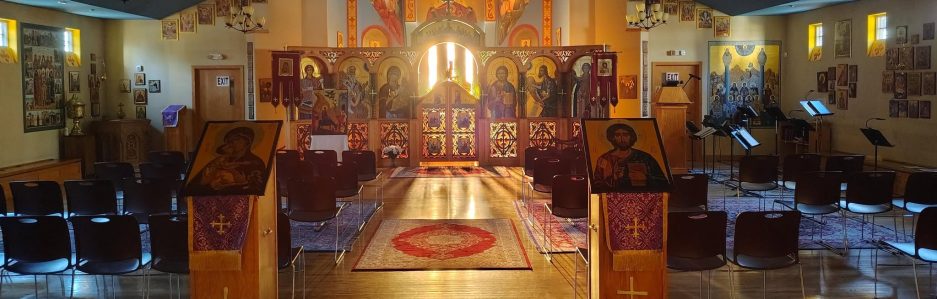
Heat was just coming on in the church when we arrived so there was the kind of cold of cement bricks still lingering when we stamped our feet, turned on the lights, and set the copy machine to its morning warm up. The routine is always the same and the old building gradually takes on a kind of life as task to task prepares us for the Liturgy ahead.
LaCrosse is a city set on the only level ground around and pushes up to the eastern bluffs of the valley until the angle and height allows no other dwelling to be built. In the hills beyond the town there are cuts in the terrain called coulees where valleys, sometimes tight and vertical and other times gentle and rolling, have been carved into the land by the effects of water and time. Roads snake through these valleys and cling to their sides as they wind into the city below. Snowy days mean that travel will be slow and as morning prayers give way to the Liturgy one can tell people are arriving even if your back is to them by the sound of the door and the stamping of snowy shoes. When you live in the hills you arrive exactly when nature allows.
But the turnout is good for such a day and the faces are familiar. In a small parish no one is ever lost for long. If you crave the anonymity of slipping into the back row of a large and darkened cathedral you will not find it here. So, too, is the assurance that people are here because they want to be, especially when the snow is thick and full.
This old parish has been around for some time by local standards. There were a lot of lean times and decades when Priests came by only now and then to celebrate a wedding, bury the dead, or serve the Liturgy for the sons and daughters of the immigrants who founded the church. Lacking the money and importance that comes with a big city the church spent most of the last century drifting here and there. And the grandchildren, with no certain parish, drifted away to wherever lost generations go and we see them now only at funerals.
At times it seems like we’re a clutch of birds huddled against the cold wind or the last remnants of a heroic regiment marching in a parade with tattered uniforms and old medals we bring out for the occasion. But not today. Because somewhere inside of us there must be some ember still burning, a smoldering wick, some flickering light that keeps us coming to this place on a day when lesser folk look out their window, roll over, and go back to sleep.
And as long as there is, it still matters.


