I'm not sure…

how it all came about but some time ago I stopped being interested in being erudite, wise, the person with all the right things to say, and the center of the party. I’ll never know all the quotes of the Fathers, never be conversant in the details and history of the rubrics, or laugh at a joke in Greek. I could try, I suppose, but the whole thing seems to me like too much work and extremely high maintenance.

Quite frankly I was never good at it. The whole attempt just felt awkward to me and so I suppose its just wise to let things ride. I’ve studied many things. I have read books.  I have degrees.  You’d want me on your side in a game of Trivial Pursuit, really. Yet in the end its all stuff and the world already has more stuff than it needs.

It’s good to be simple, to travel straight lines and have a sense of wonder. If I can love God that is enough. Time is short and knowledge for its own sake, or recognition, or any of those kinds of things are never eternal. The captain of the football team dies just like the person playing flute in the band and very little that we’re told is supposed to matter really does.  

Love God. Care for others. Live quietly in and on the Earth. There’s not much else after that which isn’t subject to the changes of the world, to the erosion of time. to mortality.

Just be simple, do good work, love others, and  live as best you can at peace.  The rest seems to be, well, just the rest.

From time to time His Grace, Bishop Thomas, currently administering the Diocese of Toledo and the Midwest sends Priests interesting articles and bits of information. This one is particularly good and needed. 


WASHINGTON BUREAU: Terry Mattingly’s religion column for 12/07/11.

      At first, there didn’t seem to be much an 80-something grandmother
could do to help her church’s college freshmen wrestle with the trials
and temptations of their first weeks away at college.

      After all, she knew very little about Facebook, YouTube, online
homework, smartphones or texting, let alone “sexting.”

      She did, however, know how to write letters. So that is what she did,
writing personal letters to each student to let them know that she was
praying for them, wishing them the best as they searched for a college
church and looking forward to seeing them at Thanksgiving and
Christmas.

      According to church members, the “students sought her out and rushed
to give her hugs and to say, ‘Thank you,’ whenever they came home,”
said Kara E. Powell, who teaches at Fuller Theological Seminary in
Pasadena, Calif., and directs the Fuller Youth Institute.

      However, another church member later stressed that the researcher had
not heard the whole story. “Instead of writing one letter and that was
that, she had actually written a letter to each of the students every
week,” said Powell.

      This was one of the most striking stories that the seminary professor
heard while doing follow-up work for the Youth Institute’s six-year
College Transition Project, which followed 500 Christian young people
as they jumped from high school to college.

      The goal was to find strategies for parents and religious leaders who
wanted to help teens develop a personal faith that would “stick” when
tested. The research was released earlier this year in a book entitled
“Sticky Faith: Everyday ideas to build lasting faith in your kids,”
written by Powell and another Fuller colleague, Chap Clark.

      The letter-writing grandmother, said Powell, was an example of one
major lesson discovered during this process. After years of
“segregating” teens off into their own niche, age-specific worship
services and programs, there is evidence that young believers also
profit from intergenerational contacts, conversations and mentoring
projects with senior adults. Young people are also more likely to
retain their faith if they helped teach the faith to the very young.

      Right up front, the researchers admitted that the young people in
this study had higher than average grade-point averages, were more
likely to have been raised in unbroken homes and had grown up in
churches large enough to employ youth ministers. That was the point.

      Nevertheless, some of the results were sobering.

      * When studies are combined, it appears that 40 to 50 percent of
“churched” young people will abandon their faith — at least during
the college years.

      * Only one in seven young people in the Fuller study felt they were
ready for the personal, moral challenges of college.

      * Events in the first two weeks establish patterns for many college
careers, especially those linked to alcohol, sex and involvement in
religious activities.

      The finding that will inspire, or trouble, many parents, according to
Powell and Clark, is that the faith practiced by most young people is
rooted in the beliefs, values and choices that they see practiced in
their own homes. If young people see their parents praying, it’s more
likely that they will pray. If they hear their parents weaving faith
into the joys and trials of daily life, it’s more likely that this
behavior will “stick.”

      It’s one thing to talk to children, said Powell. It’s something else
to find ways to truly communicate — two-way communication — with the
young about faith, doubt, temptation and forgiveness. Breakthroughs
can take place while discussing everything from homework to movies,
from a parent’s confessions about mistakes in the past to a child’s
hints about his or her hopes for the future.

      “We are not saying that it will help if you lecture to your children
about faith,” she said. Instead, the goal is for “every parent to be a
student of what their children love and, whether its sports or movies
or who knows what, to be able to engage their children on that topic.
You have to ask, ‘What is my child passionate about?’ You also have to
be honest and let your children know what you’re passionate about.

      “Then you have to ask how you can bring faith into those
conversations so that you can share your faith journeys. There is no
way to force this. If it isn’t happening naturally, the kids are going
to know it.”

 Terry Mattingly (www.tmatt.net) directs the Washington Journalism
Center at the Council for Christian Colleges & Universities.
There's an Attraction…

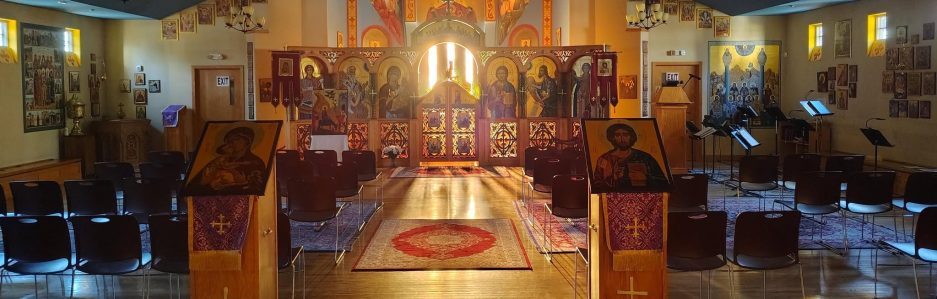
to all the canons, creeds, texts, rubrics, and services of Orthodoxy. This is probably more so for people coming to the Faith from the stripped down world of American Christianity. The richness, the possibilities, the guidance, even the sense that there’s more to faith than repeating songs on a television screen can be quite alluring.

Yet at best these are tools, not ends in themselves but helpers along the journey. They are essential and indispensible in some ways but not the end of the matter. The end of the matter is to be like Christ, to be joined to Him. Better, I think to strive to be like Christ because as you do all the canons and creeds and things that matter will be fulfilled and you lessen the risk of getting lost on your way Home while you were wandering through the books.

The Truth Is…

that the Christian life is strewn in, though, and about, with blessings. The vast majority of them are of the small but substantial kind. In some cases they are the same as an earthly blessing. Most of them will be unseen to eyes without illumination. All of them, even the smallest ones, are either eternal in and of themselves or setting us on the path to things eternal.

Why Do I Work?

Well, for the money I suppose. Is that all? There are other things. The idea that I’m helping people have better lives. A kind of joy in service. The idea of my particular work allowing me to develop and share creative energies. It all matters.

I suppose that if human sin hadn’t become part of the equation there would be little that we would call “work” in the world. Perhaps a little pruning here or there or some basic gathering of edibles. Maybe building shelters. None of the nine to five and beyond that marks the world of work these days. No need of the constant competition to get our share.

Yet the world is not that way. At best we can hope that our work allows some of what is higher, better, and holy be expressed. We will sweat and push and shovel and move, each in our own way, until the end of our lives. Most of us will place ourselves in cubicles with little meaning except for paychecks and spend our years looking out the boss’ window seeking the sun.

In the end at least part of this is our own choice. The person who works only for money may be the poorest one of all.

The Backlash…

What the Boomers as a generation missed (there were, of course and thankfully, many honorable individual exceptions) was the core set of values that every generation must discover to make a successful transition to real adulthood: maturity.  Collectively the Boomers continued to follow ideals they associated with youth and individualism: fulfillment and “creativity” rather than endurance and commitment.  Boomer spouses dropped families because relationships with spouses or children or mortgage payments no longer “fulfilled” them; Boomer society tolerated the most selfish and immature behavior in its public and cultural leaders out of the classically youthful and immature belief that intolerance and hypocrisy are greater sins than the dereliction of duty.  That the greatest and most effective political leader the Baby Boom produced was William Jefferson Clinton tells you all you need to know.

Read more here…

Pondering…

the story of the Last Supper in John’s Gospel and came to the passage where Jesus identifies his betrayer by giving him (Judas) a piece of bread. On receiving the bread the text says that the devil entered into Judas. Later, of course, the remaining disciples would also receive bread from Jesus’ hands, but this time the bread filled them with his presence. Two breads given by the same hand with remarkably different results. Jesus grant me the bread that fills me with your life.

On Love…

“True Christian love is not just a feeling or a pleasant disposition of the soul. It is a self-sacrificing, ceaseless, life-long act of heroism unto death. It is fiery yet dispassionate, not dependent on anything, not on being loved in return or having a kinship of blood. One no longer thinks of receiving something for oneself. One can be spat upon and reviled, and yet in this suffering there is …such a deep, profound peace that one finds it impossible to return to the lifeless state one was in before the suffering. One blesses life and all that is around one, and this blessing becomes universal. Such love can only come from God. This is the only love that Christ is truly interested in, the love He came to earth to show and teach humanity. With this love He gave up His Spirit on the Cross.”

Fr. Damascene Christensen of Platina