On Why…

the people on Icons look “weird”…

The way people are depicted in icons is, on the one hand, visibly decipherable as being completely human and like us. Yet on the other hand, iconographic, artistic flair portrays these dead-but-not-dead people in an abstracted, stylized way that proclaims in a poem for the eye that these people are in heaven. For an artist to paint a portrait of someone who is dead-but-not-dead presents a formidable challenge. The answer is revealed as being that “weird” look expressed in Orthodox iconography. –

See more at: http://www.soundingblog.com/index.php/art-literature/iconography/dead-people-and-why-icons-look-weird.html#sthash.T2DeUBX0.dpuf

St. Kyriaki…

Among the most steadfast of all the Saints are the virgin martyrs. Their fortitude in the face of extreme persecution humbles us who are often only mildly inconvenienced, at worst, for Christ.  Oh, to have this kind of love for Christ and this level of faith. St. Kyriaki pray for us.

st-kyriaki

Blinged out Weddings…

…I’ve since learned that planning a truly simple wedding has become practically impossible, unless couples elope or really buck all traditions. Recklessly extravagant weddings have become a cultural expectation. And brides who succumb to the intense pressure to Go Bigger can easily find themselves focused more on planning a wedding than preparing for a marriage.

Read more here.

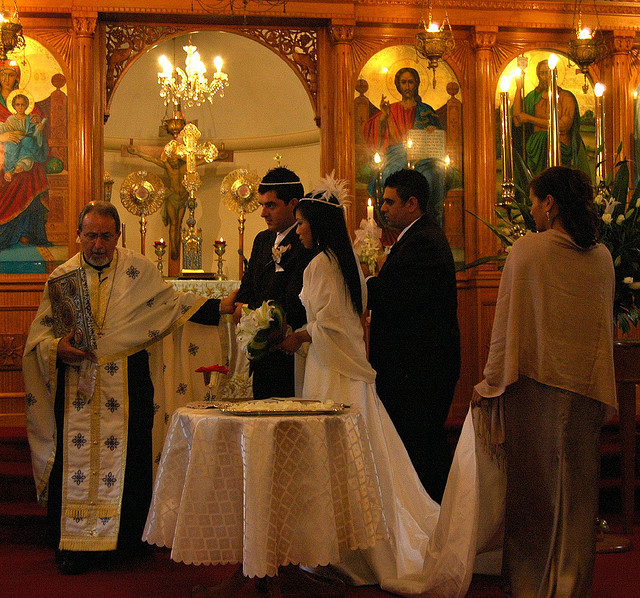
It is possible, easily possible, in the Orthodox Christian context, to have a beautiful and simple wedding. In fact one of the great blessings of Orthodox Christian Faith is that such things, guided by centuries of wisdom and practice, actually are simpler and more beautiful than having to create an “experience” from scratch.


orthodox wedding


So How Do We…

live and share our message without becoming this…

Campaigns designed to raise awareness are as much about advertising the status of the campaigners as they are about changing the outlook of a target audience. For example, advocates of breastfeeding produce literature that affirms the virtuous nature of their own lifestyles while also inviting those who have not seen the light to become aware. The very term ‘raising awareness’ involves drawing a distinction between those who are enlightened, who are aware of something, and those who are not. It draws attention to the fundamental contrast between those who know and those who are ignorant, between the morally superior and the morally inferior. So someone who allows his children to eat junk food is not only unaware and ignorant; he’s also morally questionable.


On Animals…

THE SOUL
How your Soul Differs from that of an Animal

The Orthodox Church teaches that animals have souls, although not the same as ours. When conceived, God bestows upon us the nous, which distinguishes us from the other animals. It is the nous that is the eye of the soul, intelligent and noetic, and by nature designed to commune with God. The nous is the center of man and is where true (spiritual) knowledge is validated.

Just as we are being redeemed and transformed, so is the entire cosmos. Animals are a part of this cosmos that is being prepared for the eternal Kingdom that will have no end. The kind treatment of animals reflects in an iconic way the truth that in Paradise God has called us to name our animals as Adam did, and live in communion with them. Saint Seraphim of Sarov even befriended wild bears.

Love in Christ,
Abbot Tryphon

A Good Article…

“Orthodoxy is not here by accident.”

The early immigrants would probably not have understood the meaning or implication of those words.  It is for the generations after them to understand that God used the immigration for His own purposes, and to incarnate those words into action.  America has yet to hear the Orthodox word – a word that is neither Roman Catholic nor Protestant but which echoes and resonates with the unbroken vision and preaching of earliest Christianity.  Orthodoxy was brought to America through Alaska.  Their writings and labor reveal that the original Russian missionaries keenly felt that “Orthodoxy is not here by accident” – a conviction affirmed in 1970 by the bishops of the Russian Church who gave us our “autocephaly.”  However this autocephaly will be worked out or altered in the future, mission to and for America  –  in all of its dimensions – must remain the focus and work of this generation of Orthodox Christians – because Orthodoxy is not here by accident, but by the wisdom and providence of the Lord.

Read more here.

One of the Benefits…

of these changing times may be the joy of rediscovering our first love. After all, we need to be honest and say that the larger forces in our culture, government, academia, the arts, and media, are largely unsupportive and often hostile to the ideals of Christian life, or at least the ideals as they understand them. Many are troubled. Some are angry. Yet we can be made alive and whole in ways we can’t hardly imagine if we understand.

Is it possible that in these days we are being reminded again that we are a counter-culture and probably always will be if we truly understand who we are and how we relate to the world around us? As the cultural props we counted on fall away we find ourselves as the odd ones out, the worldly power we once thought we had is evaporating and the times are changing. Our comfort levels are being challenged. Things we thought were safe and secure are not longer as we believed. We, as observant Christians, may end up on the very fringes of society.

Yet we are not called on to be fearful, angry, or hateful to the world around us and those who live in it, even if hate is directed at us. God, the Scriptures says, so loved this world that He gave His only begotten Son…, and the world God loved was not some ideal world but the very broken and dirty one that we live in. We are pilgrims and strangers in this world, we should tread here lightly, and perhaps the fact that the larger societal structures are abandoning our understandings, if they ever really held them at all, is a good thing to remind us of where our true priorities, our true home, actually lie. Yet we are a counter-culture of love, that is we seek to change the world, and change ourselves, not for the sake of power or influence in  and of themselves or for the creation of some utopian state, but rather that we would draw others to the love that is Christ.

Perhaps the rediscovery of that love is the key. Authentic Christian love is very different from the world’s definition of love with its emotional, permissive, context. Christian love flows from the character of God and is the will for the betterment of the other. For too long the observant Christians of this country have bought into the idea that the world we seek will be created by its values being part of the structures of power in our society. Such structures are always temporary, changing, and blowing in the winds of time. Love, however,  endures and the change it brings in the one who loves and the object of that love are permanent. If we wish to change the world we must love it as God loves it and enter it for the same reasons He did.

On the surface of things it may seem these are troubled times. Yet perhaps God is using all of this to call us back to that first love, His love, and to rediscover that it is in that love, living in us and shared in the world, that we find our true selves, our true purpose, and our true life. Stripped of any illusion of worldly power it may be the only thing we have left and perhaps because of it God has us right where He wants us to be, where we should have been all along.


Context…

As the larger observant Christian community deals with issues of sexuality and the popular culture it would be good to have some larger context to help our understandings. This article from USA Today was written several years ago by a conservative leaning commentator but does refer to government statistics and surveys. Did you know, for example that less than 2 percent of Americans define themselves as gay? As we live in an increasingly secular and sexualized culture knowing such things could be valuable as we live, relate, and minister within the reality of our society. Learn more here.

Worth a Visit…

During the sexual revolution, we crossed a line from sex being something you do to defining who you are. When it enters into that territory, we move beyond the possibility of having a society in which sex acts were tolerated, in the Mrs. Patrick Campbell sense — “I don’t care what they do, so long as they don’t do it in the street and frighten the horses” —and one where it is insufficient to be anything but a cheerleader for sexual persuasion of all manner and type, because to be any less so is to hate the person themselves. Sex stopped being an aspect of a person, and became their lodestar — in much the same way religion is for others. As Walker Percy wrote, “Pascal told only half the story. He said man was a thinking reed. What man is, is a thinking reed and a walking genital.”

Read more here.

On a personal note its one of the things I’ve been most puzzled about in the current discussions about sexuality, especially in the Church, the idea that a person defines themselves by their particular, and sometimes quite fluid, understanding of their sexuality. This kind of defining is not limited to people with same sex attractions. There seems to a remarkable number of people in this culture, and even those in the Church, who appear to have no problem centering their lives around their sexual activities and preferences.

To some extent I can understand this among those who have no or little Faith but for Christians the central identity of a person is and must be that of being a follower of Christ. Everything else, work, family, sexuality, politics, all of it is challenged, focused, affirmed, shaped, and made complete because Christ is the center. There are no Republican/Democrat Christians, no gay/straight Christians, the list could go on. There are not supposed to be any hyphens in our life before the title “Christian”.  Each of us has our own challenges, specific to our individuality, to rid ourselves of anything that would go before the word “Christian” in our lives and so we will all face a life of challenge and struggle in certain ways if we seek to truly follow Christ. Yet it begins, I think, with the idea that if there is something other than Christ that has priority in our life we have not fully grasped what it means to be His disciple.