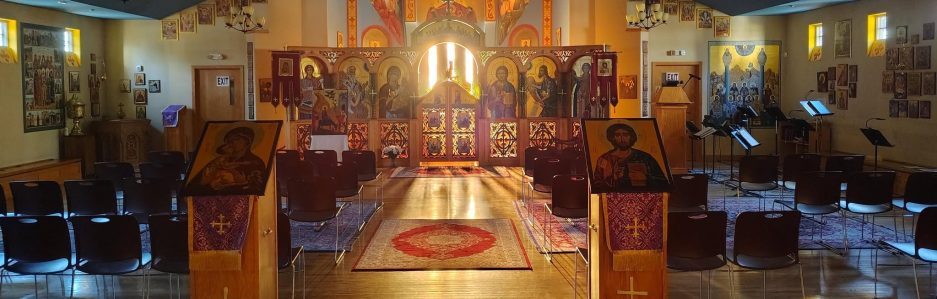
do mean a lot and I have never experienced a parish with such an efficient and competent administrative staff as that at St. Mary’s Greek Orthodox in Minneapolis. It’s like a dream world working with those folks.

For authenticity's sake…
this year’s Minnesota Renaissance Festival will be ruled by corrupt family dynasty, watched over by a compromised Papacy, and all in an atmosphere of a minimum amount of sanitary plumbing. Poor people with few teeth will get in free.
Share this:

I had the chance…
to come home early yesterday and turned on the TV. The program was “Judge Judy” a reality show where people agree to settle their disputes on the show in exchange for 15 minutes of fame. As the show proceeded, a case where two unemployed people who had found a way to bring four children into the world, she before the age of 21 were arguing over the disposition of a beat up truck, I thought “My soul is going to need a shower after this.” This morning I think that if there really are extra terrestrial intelligences out there getting our TV signals and forming opinions about us by what they see our doom is certain.
Share this:

There's no question…
these past few years have been bumpy in US Orthodoxy, especially when it comes to our Bishops. And the truth is that I don’t know either all the details or all the answers. One thing, though, seems clearer to me as the days go on and the events unfold; sometimes the people have to care for the shepherds.
Let me explain. I’ve been a Pastor in both congregational and episcopal polities and I’ve learned that when the devil wants to wreak havoc it can often come in the pattern of the polity. If the church is congregational the people get stirred up. If the church is episcopal the Bishops are attacked. People don’t understand this and often think of all the troubling things that are happening in these past few years as a matter of personalities, programs, or politics. I think we might be forgetting that there is a component of spiritual warfare in all of this.
In our case as Orthodox Christians if our leaders can be stirred up, in conflict with each other, or find themselves focused on the trees and not the forest the basic and primary mission of the Church can be hamstrung for as long as it takes to get these things worked out. Leaders who can’t agree. Leaders who listen to their passions. Those leaders will be diverted from their essential tasks and if the shepherds are struck the sheep can be scattered.
So sometimes we who are followers, with due regard for our own sins and struggles, need to reach out and deeply pray for our leaders asking God to protect them, to help them to stand for the Faith and against the fiery darts thrown at them every waking hour even as we pray for the same things for ourselves. Imagine what could happen if the Orthodox of this country prayed every day for their Bishops? Our prayers could become for them a wall of protection, a holy fortress where they can rest from the attacks of the enemy.
And imagine how that would change us as well!
Share this:

Our US Debt…
increases $3,000,000 every minute and our children and grandchildren will hate us for doing nothing.
Share this:

Opposition to abortion…
Is not just a Christian thing…
Abortion, except in cases of rape and incest and when the mother’s life is at risk, is illegal in Thailand, and for devout Buddhists it is a terrible crime. “Buddhism believes in rebirth and teaches that individual human life begins at conception,” says one commentator. “The new being, bearing the karmic identity of a recently deceased individual, is therefore as entitled to the same moral respect as an adult human being.”
Read more here…
Share this:

Congregations gone wild…
The American clergy is suffering from burnout, several new studies show. And part of the problem, as researchers have observed, is that pastors work too much. Many of them need vacations, it’s true. But there’s a more fundamental problem that no amount of rest and relaxation can help solve: congregational pressure to forsake one’s highest calling.
The pastoral vocation is to help people grow spiritually, resist their lowest impulses and adopt higher, more compassionate ways. But churchgoers increasingly want pastors to soothe and entertain them. It’s apparent in the theater-style seating and giant projection screens in churches and in mission trips that involve more sightseeing than listening to the local people.
Read more here.
Share this:

The weekend is done…
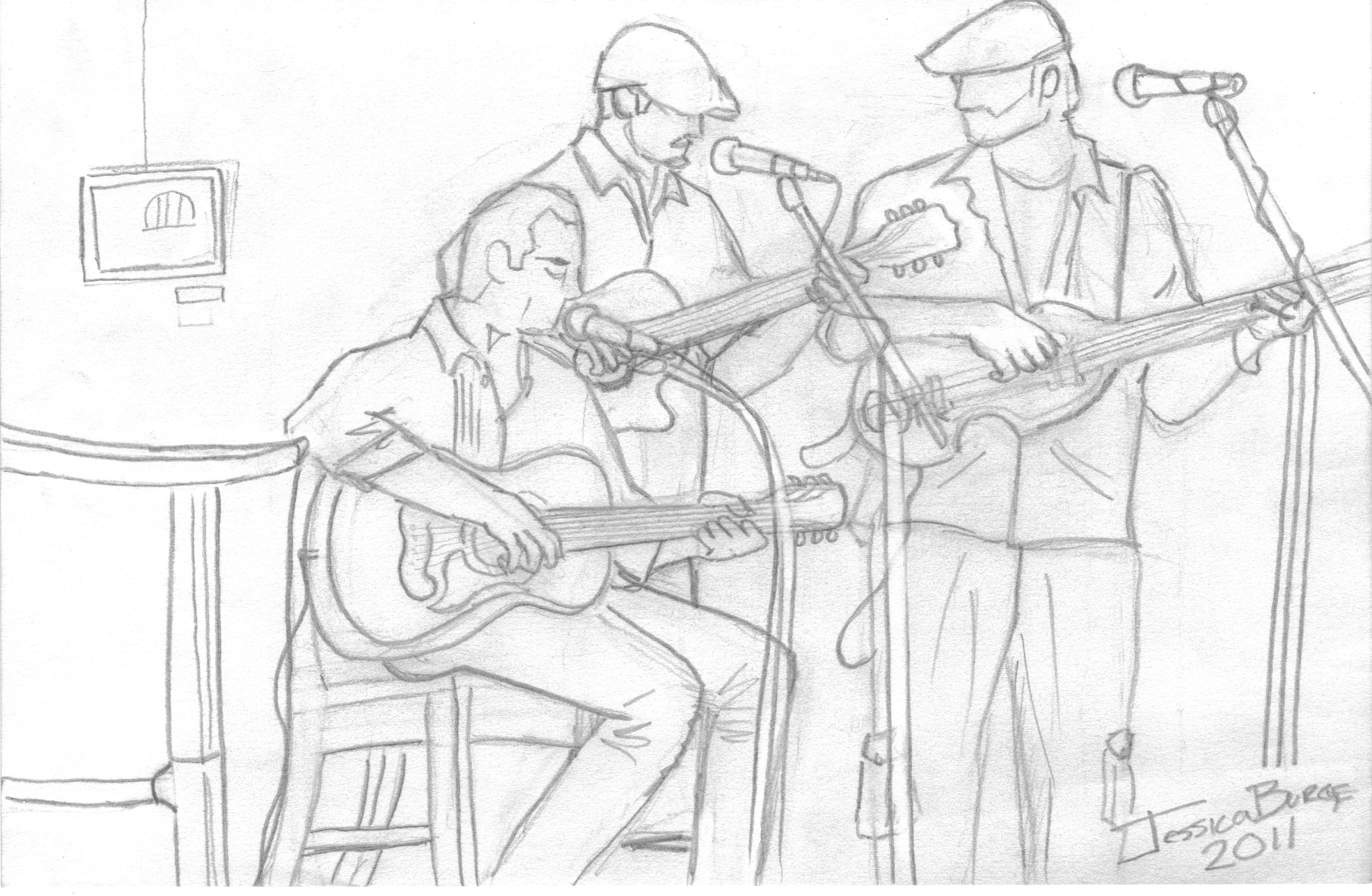
Four services, four shows. I’m tired to the bottom of my feet but grateful to God for the strength to make it through. Constant repetition has made the music flow. Services in different jurisdictions has been the best possible education. I have no idea where all of this goes, but today is good, tired and all.
Here’s a sketch of “Shoulder to the Plow” last night at the Dunn Brothers Coffee Shop. I’m on the right.
Share this:

Interesting thoughts…
From: AOI Observer | By Fr. Johannes L. Jacobse
Progressive fads sweep through the culture like clockwork. Remember the impending global ice age in the 1970s that morphed into global warming today? How about the fight about abortion where anyone who dared criticize it was branded as a hater of women? Remember the Equal Rights Amendment and how convinced its supporters were that it was absolutely necessary for a just society?
None of these movements should be taken lightly of course but that doesn’t disqualify them as fads. There is always a strong strain of self-justification among Progressive Culture Warriors; a posturing that creates a facade of virtue and labels the critic as ignorant. Fellow travelers bask in that warm glow of imputed righteousness that they generously confer on each other. The rest of us can return to our caves.
That kind of arrogance informs the new Facebook group “Listening: Breaking the Silence on Sexuality with the Orthodox Church.” The tendentious title is the first clue something is seriously skewed. What silence needs to be “broken”? Who are the people breaking it? Is the Orthodox Church really silent on sexuality?
As it turns out, the only sexuality that concerns the “Listening” group is homosexuality. They are preoccupied with it. They oppose the prohibitions against homosexual behavior in the Orthodox moral tradition. The prohibitions go back to Apostolic times, but their rejection of them is only whispered — a silence they still don’t want broken apparently.
The Invitation To ‘Dialogue’
We’ve seen these arguments before, particularly in the Episcopalian Church that has been largely decimated by homosexual activism in the last three decades. Liberal activists overtook that once noble communion and forced the traditionalists out the door. The prognosis is dire. (See: When the Lights Go Out: The Death of a Denomination, and What Does The Future Hold For The Church Of England?)
The decline started out innocently enough. Traditionalists were invited to “dialogue” (a favorite term) about lifting the moral prohibitions against homosexuality. Many of the arguments heard on the Listening group were ones first uttered by these Episcopalian activists. Some were even true especially the assertion that we need a better understanding of homosexual pathology, that some homosexuals have suffered, and that some young people don’t know how to deal with homosexual feelings, among others.
Nevertheless, accepting the invitation to dialogue undermined foundations. When the operating assumption is that the moral tradition is wrong in its prohibitions, then the only way dialogue can be meaningful is when the traditionalist detaches himself from the authority of his tradition.
We call this moral relativism where no abiding truth, no moral universals, are believed to exist. Truth becomes relative. The touchstone for truth is not God but man, and every man is free to decide for himself what is true and what is a lie. In the dominant culture moral relativism reigns supreme. In the Orthodox Church however, we guide our lives and decisions according to the tradition we have received.
The traditionalist entered the dialogue with the deck stacked against him. As it turned out, the invitation to dialogue was a ruse, a way to undermine the confidence the traditionalist had in his tradition and ultimately many were driven out. The activists ascended into positions of authority so that when the purge of traditionalists began, they were able to hang onto the buildings, endowments, and key ministries. Today, the traditionalists are exiled in the desert.
My ’Dialogue’ With A Moderator of the Listening Group
No one is arguing that the Facebook activists have motives this sinister, but their thinking is no different than their Episcopalian counterparts. Consider this “dialogue” I had recently with one of the group’s moderators:
The moderator (and founder) wrote:
“We” (Orthodox Christians supportive of and participating in the kinds of dialogue we have in the Listening group) and “you” (Orthodox Christians opposed to this dialogue), have, sadly, become enemies. It seems to me that dialogue between us is not possible right now. This should be a source of grief rather than anger. It is for me. In this situation I want to try to take very seriously our Lord’s admonition to pray for our enemies. That simple teaching contains one of the great, inescapable truths of the Gospels. I think it’s the best thing we can do, and it’s a very good thing. I very sincerely ask you—readers of this site—to pray for us. And I sincerely offer my prayers on your behalf as well. May God bless us all, grant us all a spirit of repentance, and lead us all to Truth.
My response:
Pardon my bluntness, but your argument has the odor of sanctimonious posturing. The language confirms it: “This should be a source of grief rather than anger,” or “In this situation I want to try to take very seriously our Lord’s admonition to pray for our enemies,” for example. You imply that we should join together in feigned concern over a division that you have created. No thanks.
In reality the divisions are clear: One group approaches the prohibitions against homosexual behavior as an open question and the other regards it as closed. And no, the traditionalists don’t see the liberals as “enemies” but as flat out wrong. There’s a world of difference between the two and any prattle about “loving your enemies” blurs this critical distinction. Frankly, using the injunction to “love your enemies” to justify your notion of dialogue abuses the moral vocabulary. Any Christian who has faced the task of forgiving a real enemy knows this.
My response was harsh but necessary. Obscuring real intentions with overwrought language (what I call “Ortho-speak”) is an occupational hazard with us Orthodox and it is fully evident here. If the language of the moral tradition is employed in ways that undermine it (whether or not the moderator is aware of it is irrelevant), then strong reproof is warranted. The moderator must understand that for the Orthodox the question about moral prohibitions is closed. No dialogue is needful or desired.
If we want to think clearly, then we have to deal with what words really mean, not what we want them to mean. And no amount of self-justifying rhetoric about this or that putative virtue lifts this requirement. There is no “grief” or “hatred of one’s enemies” evident here. We only see muddled thinking and the ignorance of the neophyte.
Guideposts Keep Us On The Path
The moral prohibitions serve as guideposts, as warnings or barriers to us. If we cross them, then we enter onto a path that leads to death instead of life. God is merciful and has provided us the way out of the death into which our sins have led us. But what happens when sin is not called sin anymore? What happens when the guidepost is removed or the warning muted and the barrier taken down? Then we walk in darkness. The way to salvation is harder to find.
That’s one of the gravest threats the Listening group presents. If they succeed in removing the guidepost that names homosexual behavior as sin, then they also remove the hope that the person struggling with same-sex desire has for healing from God. In theological terms, the group preaches an incipient antinomianism; they stand against the law of God even though they cover their rebellion with the language of benevolence and compassion. (See: The Challenge of Antinomianism: You Mean the Gospel Isn’t All About Mercy?)
The Listening group needs to unplug their ears and hear this: When the moral prohibitions are discarded, then the anthropology to which they point is jettisoned along with them. The prohibitions do not exist in a theological vacuum. They draw from deep insight and knowledge about the human being that in some cases took centuries to comprehend and develop and serves today as the foundation to better understand homosexual pathology and how to deal with it.
Moreover, when the anthropology is jettisoned, something else has to take its place. If one really believes that the moral tradition has nothing to say about sexuality (the Church is “silent,” remember?), then ideas from popular culture will be solicited to fill the vacuum. But many of these ideas are false.
For example, one dominant assumption of the group is that homosexual identity is fixed. The jury is still out on this. The Center for Disease Control just released a study (.pdf) that only 1.7% of the population is homosexual and 35% of this number is bisexual. The study cites that only approximately 420,000 people in all of the United States are actually committed homosexuals. Many men move into homosexuality for a season and then move out. Homosexual self-identity is not as fixed as the gay lobby or the Listening group would have us believe. (See: Centers for Disease Control and Prevention Study Says Only 1.4% of Population Homosexual.)
Another assumption is that if one criticizes the dominant homosexual apologetic, then one lacks the compassion to effectively deal with the person struggling with same-sex desire. This is perhaps the most pernicious misconception of all because it disqualifies the traditionalist a priori and thus excludes the anthropology that needs to be brought forward.
So Who Really Is The ‘Listening’ Group?
The point that must be understood is this: If the Listening group believes that the Church is “silent” on sexuality and that they have been called to “break” that silence, then the source of their thinking has to draw from something other than the moral tradition. Their purpose then is not dialogue. It can’t be. Rather they want to be the gate-keepers, the commissars of acceptable ideas and speech. It simply cannot be anything else.
Unfortunately many in the group display an immaturity and ignorance about the ideas that they champion. They are probably not aware of it, but they function as the religious arm of Gay Inc. – a term familiar to more discerning observers of the culture. (See: The Bad Faith of Michele Bachmann’s Gay Rights Inquisitors.)
They also enjoy berating converts (“American Orthodoxy has a convert problem” is a favorite refrain applied to their critics) but who really are the neophytes here? They collect the ideas of the dominant culture, swash them with a religious patina and call the enterprise Orthodox. But we aren’t interested in repeating the Episcopalian project in our Orthodox Church, thank you. Maybe they would be more comfortable in the new and improved Episcopalian communion.
The Listening group has to stop dragging the culture wars into the Church. The prohibition against homosexual behavior is a closed question. The moral tradition does not need to be retooled and there is no need for “dialogue.”
True compassion sees the person struggling with same-sex desire as a person first and not as a “homosexual.” That’s what our tradition teaches. False compassion redefines the person in terms of his passion. That’s what the homosexual lobby teaches. Throw out the prohibitions however, and this distinction is lost. The knowledge that informs them will be lost with it.


