
Indeed…
Life Along the Orthodox Way


is not the real world. Don’t get me wrong, its not an illusion its just not the world as God intends it. There is a brokenness in it that has distorted it from its original design, purpose, and reality and so there is a kind of unreality, a sense of it being skewed, that permeates it. There are markers of the real world in this world but the fullness seems always just out of our grasp.
The Kingdom of God is the real world, the world as it should be, a world restored to its design, purpose, and destiny by the One who created it in the first place. It is also real and can be experienced in time. The difference between the Kingdom of God and the world we experience is that the Kingdom of God, its values, its Faith, its vision, embody the fullness of what God intends and the fullness of what it means to be a human.
This creates a tension for the observant Christian. We live in a world that has an unreality to it because it is good, because it was created by God, but broken because it is tarnished by human sin and mortality. We experience this brokenness in so many ways and the power of it can often be overwhelming. Even if we are truly convinced there is more and better that more and better can seem far away and extraordinarily difficult to achieve. We also live in a another world, as it is, a world we call the Kingdom of God the reality of which sometimes intersects the world we experience every day but also has the potential to alienate us from it as well.
The result is that we are travelers in time. We live in places and share the common lot of those who share this time and place with us yet we also know that even in its best moments our experience is touched with the sadness, sin, and death that has been horribly inserted into this realm. And its hard to live that way, caught between two worlds, the world we were born into and the world we called to. Choices have to be made. Loyalties need to be discerned. Where, in the end, do we belong? To what world will our final allegiance be given? Jesus was so right when He said our heart would be where our treasure is.
In these times, when the veneer of respect for our Faith is rapidly wearing off in the public arena, where the times are growing dark as people in greater numbers seem to have cast their lot with this world, and where even people who were entered the Kingdom are now looking over their shoulders at the world they left behind, we will all be tested. What realm can lay claim to our true citizenship? What storehouse holds our true treasure? Which world’s thoughts will become our thoughts? And the stakes may be eternal.
The answer? All I know to do is to stay as close as possible to Jesus and together we’ll ride out the storm and make it safely home.


10 Things Orthodox Christians Would Like You to Know by Dn. Charles Joiner

have either given up or are loosening the grip on their territorial colonies the urge to colonize, to walk into another person’s world with instructions for right living and social order and then use means to establish such an order appears to have continued unabated. This time the forum is culture.
My own country is an example. Along with military presence perhaps the greatest single export of the United States is in the world of ideas and culture. Gone are the days, of course, where prim American missionaries would go around the world telling people in hot climates to dress like they do in Boston or they won’t actually be Christians. Now the new American missionary produces television shows, commercial products, multinational companies, and whatever culture that comes in the package with them.
Increasingly and sadly that culture is often rotten, a sick mix of violence, promiscuity, and consumption for its own sake. We have found a way to export our consumer goods and the emptiness of soul that comes in the same box. We have a veneer of charity but the people receiving it know that its the overflow of our excess. We have become evangelists every bit and more enthusiastic than those who brought Bibles for an anti- gospel, if you will, that is less enlightening, a message of power, greed, promiscuity, and a life given over to acquisition.
And when the people we send these things to are hesitant to embrace them our vaunted tolerance and diversity turns into a snarl. Witness the cultural belittling of Russia simply because they don’t wish to have teachers in their grade schools showing children how to put condoms on bananas and exploring anal sex in their early teens. The barbarians must embrace the new religion or be taught a lesson. Witness how our aid is distributed to the poor and needy throughout the world on condition that they embrace the instructions that come with it or risk having that aid be removed. Witness, as well, that when people refuse to embrace this way of life we propose we strive to shut down their economies or send our drones to enforce our will through death.
Who is the culture killing, soul deadening colonial missionary of this day? It is certainly not the man or woman with a heart for God and a desire to build a health clinic in a place of poverty. I would suggest, instead, that the true colonialists of our time often wear business suits and come with technological baubles in hand that catch the eye but have strings, even chains, attached. They are emissaries of a “modern” world whose technological benefits are quickly being overcome by its moral and spiritual emptiness. What good is a television that spews social filth or an industrial base that produces temporary junk made by disposable people?
Thus the resistance. People around the world have television and the internet. They see not just the trappings of who we are but the reality that often underscores it as well. They see the tragedy behind the glittering lights. They understand the emptiness behind the manicured smiles. And they want very little of it. Pure water, constant electricity, advanced medicine, absolutely. Mindless consumption, moral drift, women who twerk and men who enjoy watching them, not so much.
And its in our best interest to let them be exactly who they want to be. You see, some day when our emptiness makes its full run, when the measure of our pride and sin is full, and when the mirage of the world we’ve created melts back into the desert of reality we’ll need those people who were wise enough not to buy everything we were selling. If God is merciful to our cries they will come to us and teach us how to be human again.

Understand two thoughts, and fear them. One says, “You are a saint,” the other, “You won’t be saved.” Both of these thoughts are from the enemy, and there is no truth in them. But think this way: I am a great sinner, but the Lord is merciful. He loves people very much, and He will forgive my sins.
– St. Silouan the Athonite
Via the OCA Bulgarian Diocese Facebook Page

When St. Amphilochios was asked how to avoid despair over reoccurring sin, he answered with the following account:
“A certain brother, overcome by the passion of immorality, sinned every day. However, each time, with tears and prayers, he would fall before Christ and receive forgiveness from Him. And as soon as he had repented, the next day, being misled again by shameful habit, he would fall to sin again.
After having sinned, he would go to the Church, prostrate himself before the Icon of our Lord Jesus Christ and tearfully confess: “Lord, have mercy upon me and takeaway from me this fearful temptation, for it troubles me fiercely and wounds me with the bitter taste of pleasure. O my Master, cleanse my person once more, that my heart might be sweetened and thankful. My Lord, on my word, I will no longer commit this sin.”
And though his lips had just whispered these words, no sooner would he leave the Church than he would fall once again to sin. This happened not for one or two or even three years, but for more than ten years.
One day when all that we have described again occurred, the brother, having fallen to sin, rushed to the Church, lamenting, groaning, and crying with anguish, to invoke the mercy of God, that He might have compassion on him and take him from the sin of immorality.
No sooner had he called on God, the lover of man, than the Devil, that destroyer of our souls, seeing that he could gain nothing, since whatever he accomplished by sin, the brother undid by his repentance, became infuriated and appeared visibly before the brother. Facing the Icon of Christ, the Devil said to our compassionate Savior: “What will become of the two of us, Jesus Christ? Your sympathy for this sinner defeats me and takes the ground I have gained, since you keep accepting this dissolute man and prodigal who daily mocks you and scorns your authority. Indeed, why is it that you do not burn him up, but, rather, tolerate and put up with him? To this fellow here, even though an immoral man and a prodigal, you calmly show your sympathy, just because he throws himself down in front of your Icon. In what way can you be called a just Judge, then? The Devil said all of this, poisoned with great bitterness, while there poured forth from his nostrils a black flame.
Having said these things, he fell silent and a voice from the sanctuary answered him, “O, all-cunning and ruinous Dragon, are you yet not satisfied with and destructive desire to gobble up the world? Now you have even the nerve to try to do away with this man here, who has come with contrition to entreat the mercy of my compassion to devour him, too? Can you offer up enough sins that, by them, you can tilt the balance of justice against the precious blood which I shed on the Cross for this man? Behold my murder and death, which I endured for the forgiveness of his sins.
“You, when he turns again to sin, do not turn him away, but receive him with joy, neither chastising him nor preventing him from committing sin, out of the hope that you might win him over; but should I, who [taught my disciples] to forgive sins seven times seventy (Matthew 18:22), not show him mercy and compassion? Indeed, simply because he flees to me, I will not turn him away until I have won him over. I neither turn away nor reject anyone, even if he should fall many times a day and many times return to me; such a person will not leave my Temple saddened, for I came not to call the righteous, but to call sinners to repent. Look at this man who a few moments ago repented, having returned from sin and having fallen at my feet with a sincere resolution to abandon sin, has thereby conquered you.”
While [all of] this was being said, the repentant brother had thrown himself before the Icon of the Savior. With his face to the ground and lamenting, he surrendered his spirit to the Lord. From this incident, my brothers, let us learn of the limitless compassion of God and of His love of man, that we might never again be disheartened by our sins, but rather look after our salvation with zeal.”
Via the Facebook Page of Fr. Thaddeus Hardenbrook

Another study indicating that people with a regular spiritual life may suffer less stress and depression.

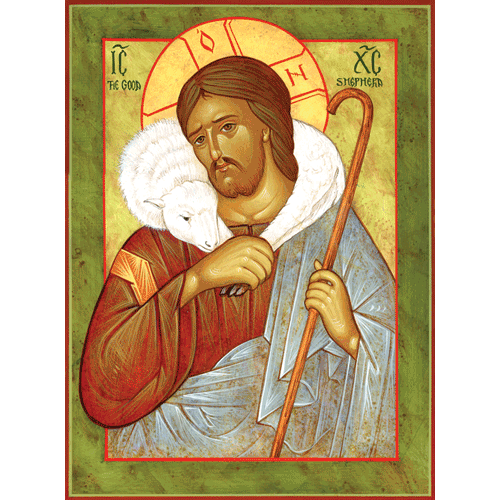
From Philippians chapter 3…
I want to know Christ—yes, to know the power of his resurrection and participation in his sufferings, becoming like him in his death, 11 and so, somehow, attaining to the resurrection from the dead.12 Not that I have already obtained all this, or have already arrived at my goal, but I press on to take hold of that for which Christ Jesus took hold of me. 13 Brothers and sisters, I do not consider myself yet to have taken hold of it. But one thing I do: Forgetting what is behind and straining toward what is ahead, 14 I press on toward the goal to win the prize for which God has called me heavenward in Christ Jesus.

A potential link between practicing your faith and lowering the risk of depression.

 The Beautiful Path