It’s 2008, day two, and I’ve got a few resolutions.
I’d like to lose some more weight. I’ve got a case of the usual American gluttony and really need to drop about 20 more pounds or so (I’ve lost about 25 since October).
I need to get to confession at least once a month. You’d be suprised at how hard it is for a Priest to get to confession especially if they’re the only Orthodox Priest in town!
This year I’m going to get at the mandolin and really make the time to practice it and gain expertise.
Oh yes, get organized, always get organized. And turn off the TV because some days it can be like having the spiritual equivalent of an open sewer in your home.
Now I don’t know exactly how I’ll do on some or all of these. All I can say is that I feel motivated in a way I haven’t before. Midlife crisis? Best laid plans of mice and men?
We’ll see.

Some wisdom from the Wall Street Journal…
An article on deconstruction, gender, and culture. A reminder, as well, about why what we beleive and practice makes so much of a difference in the face of a culture embracing its own death wish.
Share this:

Filed under "I couldn't resist…"


On the Prowl…
Got a ticket yesterday, actually just a warning.
Just north of Frontenac, Minnesota on Highway 61 I saw a State Trooper pull up fast and turn on the red lights. I was puzzled but pulled over. He asked me if I knew how fast I was going and I said, “About 55 or 60.” “Oh, and did I know that I had an illegal license plate bracket?” (That would be the one the dealer put on the car).
When the Trooper came back it became clear that he didn’t know my speed either but I had apparently passed someone on the road that had been going 55 and so I must have been going faster. Oh, and when I get home I should probably take that bracket off the car.
My guess? It’s around New Year’s and the Troopers are out doing some intensive checking for drunk drivers. If they stop you, even if they really have nothing (or something as silly as what they determine to be an “illegal” license plate bracket) they get to check things, your car and you, out and dig a bit. When he found out I was stone cold sober, and have been for almost three decades, hadn’t had a ticket since 1984 and generally so boring that my local Red Cross calls me all the time to give blood, he gave me a warning so I got out of it and he saved face.
Better luck next time.
Share this:

Sometimes its obvious…
You know when you’ve been staying at a hotel for a lot of weekends in a row when THEY send you a Christmas card! Got it in the mail a few days ago.
Share this:

Some wisdom from Michael Coren…
On the National Post
Share this:

Nativity Eve Homily…
December 24, 2007
Many years ago around this time of year I would read the story of Christmas from my grandmother’s Bible. It was the King James Version, with all the “thee’s” and “thou’s” intact and words like “holpen” and the classic “my soul doth magnify the Lord…” There was something about reading that most wonderful story in a kind of English now far removed from the banality of every language. There still is.
And the story itself is wonderful, profound, full of angels, shepherds, and wise men coming from distant lands. Imagine what it must have been like to see the sky lit up with angels in the small hours of the morning! How can a heart not be drawn to that first cry, the sound of the king of glory entering his own world in a humble cave. Truly all the artificial and commercial trappings of this time pale compared to the simple richness and depth of that night recorded by those who came to know and love Jesus.
But the greatest wonder still remains, not in the details, but in the why of it all. Why would God do this? What compelled God to come to this little blue circle in the depths of space and pay us any heed at all?
Our faith tells us that God has no need we can fulfill. God is complete in His Trinitarian unity, fully self-sufficient, perfect within himself. To survive we humans need each other but God has no such need for any other than himself.
And frankly it should be noted that our record as a species on this planet has been remarkably less than stellar. Had this world been created without people it would still be a pristine paradise, it’s inhabitants living without preying on each other in a garden of plenty perfectly created and maintained for life. No one can argue that God would, having placed us here, be perfectly just in simply speaking a word and destroying everything to rid his creation of the pests we have become.
Yet God chose to create, and God chose to create us. And then when we had become the most serious kind of nuisance and by our sin infected the whole of what he had made, he chose again not to destroy us or abandon us in an endless cycle of brokenness but rather came to us in the most humble of ways, a million times more profound than a human becoming an ant, to save us from ourselves.
There is no reason for this that any human can fathom. But in the glimpses and shadows we do observe we can at least partially understand the existence of a kind of love, awesome in its magnificence, unsoundable in its depths, a love that the keenest intellects and holiest souls only see in the smallest of fragments but yet is real and perpetually reaching out to us from the very heart of God.
There simply is no human equivalent to this. It eclipses us. It shatters our feeble attempts to comprehend it. The appreciation of even the smallest bit of it can pierce our soul and tear every bit of darkness out of us. And if by some measure of pride or hubris we think we may possess it, it humbles us and we stand in a place beyond words, capable only of awe.
It’s the “why” of this night, as St. John says, “For God so loved the world that he gave his only begotten Son…” This love is what makes this night holy. This love is the gift beyond all others. This love remains the song of angels calling us to the hope of hopes and the star that leads all who are wise to Christ.
Share this:

A Bit of Christmas Humor…

Share this:

Next Sunday's Homily in Advance…
Sunday of Geneaology,
December 23, 2007
When I was first seriously inquiring about Orthodoxy I remember attending liturgy and hearing today’s Gospel comprised mostly of a recounting of Jesus’ ancestors. I have to admit my first thought was probably, “What an odd Gospel,” difficult to chant, almost like reading the phone book. Certainly there would seem to be easier texts to preach from, especially this time of year.
And for the most part when preachers approach this text they do it for scholarly reasons, seeking out and explaining, for example, the differences between the genealogy in Matthew and Luke. Some focus on the order and number of the listing. It’s also very common to pull individuals out of the list and do homilies about their lives. Others will speak of how theologically and socially these lists were important to the authors of these Gospels.
Those are all good reasons to read the text and good reasons for the Church to include it in Her ancient cycle of readings. To know the Scriptures requires not simply reading easier texts and avoiding ones that take a certain amount of work. All the Scripture was approved by the Church and all is worth reading even if the message is not immediately clear and the first question is “Why is this important?” To be Orthodox is to be a serious and inquisitive student of Holy Scripture.
And my own ponderings of this text helped me recall something very important in this text, something that underscores all of the content of the New Testament and the stories of Jesus’ life. The scriptures contain many kinds of literature ranging from poetry to apocalyptic writings like the books of Daniel and Revelation, from love songs to historical accounts, ponderings on the nature of things to individual tales of courage and more. One can often see the form of the literature simply by reading it. The Psalms, for example, are poetry and liturgical hymns, the book of Esther is a historical tale designed to draw out faith and trust in God, while Job, not a historical book, is a drama of man pondering the meaning of tragedy and faith.
In this very beginning of the New Testament, of the stories of Jesus, his followers are, by placing this genealogy at the head of the text, locating the story of Jesus not in some mythical place and time but directly in human history. Jesus is a real person with a real family who really existed in time and space as we know it. After all isn’t our family our first and primary place in history? In the context of our family we enter this world and rooted in it we live our lives and in the end our family is more than likely the only vessel that will carry our memory through time. Our spot in the family tree marks the fact we were truly here.
Some decades after Christ’s resurrection there would be a group of heretics called the docetists who would deny that Jesus was real, a human being. He was, they would say, a kind of being that only appeared to be physical. Later skeptics would look at history and observe that in some places and times there were myths about women giving birth to gods and that perhaps the story of Jesus was just another one of those tales. In our time there are those who would say that perhaps there is a core of “history” to Jesus but most of what we know of him is the product of pious embellishment by people long distant from his actual life.
To each of these St. Matthew and the whole of the New Testament would say “No, he had a family, he walked among us and we saw what he did, heard what he said, touched him, saw him die, and then witnessed his resurrection. We knew his Mother, met his relatives, ate with him, prayed with him, traveled with him along the road, and our lives were transformed by it all. This is not about once upon a time in a land far, far, away, but about real time, real people, real places, and real history. It’s not, as the writer of the Epistle of Peter would say “cleverly devised fables,” but about what we saw with our own eyes, what really happened, this is history, remarkable for sure but ever so real. You can even check the genealogy”
And there is a confidence in this for us as we live as Orthodox Christians. In our day and age it’s fashionable to think of religious belief as a story we invent to help us become better people or perhaps cope with our fears and inadequacies. But our story is not a human invention. Those who witnessed it and passed it on were very careful to include names and dates and places that were easily verifiable to those who first read them and even to history. They did this so others would understand all of this not as something created in the desperation for answers but rather as the recounting of how God in mercy came to us and how we can truly be transformed because of it.
Next year, if our Lord does not return, you will hear this reading again. And when you do let it, in the recitation of the names, call to mind something far greater, the truth that all we will hear about Jesus, beginning with this story is real, and because of it so is our life of faith and our salvation. And as you ponder that everything about this holy season will change for you and you’ll never be the same again.
Share this:

Death of a Church Mouse…

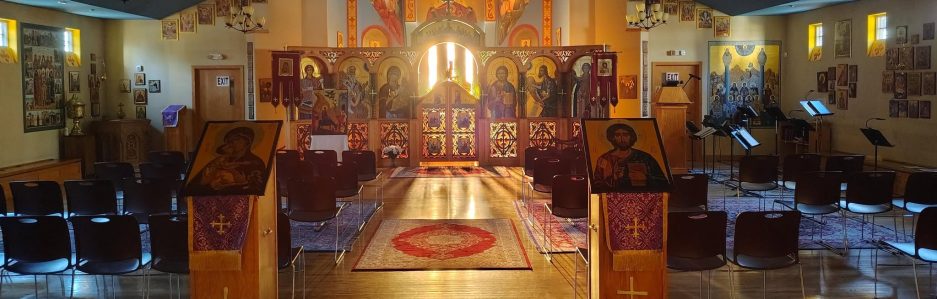
It is the custom for some at St. Elias to bring the Prosphora (the bread to be used in the Divine Liturgy) on Saturday evening and place it on a table in the sanctuary in anticipation of Sunday morning. In the past two weeks this has been the case and each Sunday morning as I came early to church to prepare the bread I have discovered the presence of our church mouse.
Apparently in the evening after Vespers is done and the church is quiet he (or she, who knows?) emerges from his home in our temple, climbs up the table and partakes in a single loaf of bread, eating his fill and then retiring for the night. On Sunday morning I arrive early to discover a small hole in a loaf with the evidence of mouse-like mastication. But this time I was prepared.
For those not from these parts you’ll need to know that as the weather cools the local population of mice seek shelter, some finding it in outdoor burrows but many coming to reside in any building they can find. For the most part they’re pretty quiet about things, running in the walls and shadows looking for scraps of food and pretty much staying to themselves. They do,however, leave little shall we say, “calling cards” wherever they live and being mice have the ability to settle in, adapt quickly, and respond to it all by having a family, a very large family. So I knew they had to go.
The truth is I’m not crazy about killing anything. Yes I know the chicken at the restaurant didn’t commit suicide but I see the taking of any kind of life as something that’s necessary but not part of the orginal plan if you get my drift. So when I have to I try to make it quick, painless, and never wanton. For mice that means what I call a “snappy trap”.
There are sticky glue traps out there that snare a mouse and then hold him fast while he struggles to death. There are live traps that capture a mouse but then what do you do with it? Unless you have a fair plot of woods around any mouse you release just becomes someone else’s problem and not many people consider giving a live mouse a definition of “loving your neighbor as yourself.” The old fashion snap trap solves much in one fell swoop. No suffering on the part of the mouse and no wondering what to do with a live one. Just a swift second, a “snap” and then everything is done.
So before liturgy this morning I set the traps in the area where I thought our church mouse might be and since he had already developed a taste for holy bread I took a bit of it from the loaf he had already sampled and placed it in the trap. I didn’t have to wait long.
About a half hour after everything was done and the upstairs of our little church went silent our devout mouse scampered out from wherever he was living and lured by the scent of prosphora stepped on to the trap. A quick inspection on my part of the traps just before leaving filled out the details. Now a new question emerges. How many mice are still with us? Being socialable critters the answer is probably more than we know. For even as our little church mouse may be, in his own unsuspecting way, devout he is no hermit.
Only time, it seems, and the two other traps laden with prosphora, will tell.


