An article from Fr. Thomas Hopko via Orthodixie.

Simple pleasures…

Writing as the night passes, warm in the house with the sound of rain outside and a cat curled up next to you on the couch.
Share this:

Solid thoughts in fluid times…
A speech given to the Acton Institute…
That when one divorces freedom from faith both freedom and faith suffer. Freedom becomes rudderless (because truth gives freedom its direction). It is left up for grabs to the most adept political thug with the flashiest new policy or program; freedom without a moral orientation has no guiding star. Likewise, without freedom and the ability to make moral, economic and social choices, people of faith have restricted practical impact. Theocracy is the destruction of human freedom in the name of God. Libertinism is the destruction of moral norms in the name of liberty. I say a plague on both their houses.
Hat tip to Orthodoxy Today
Share this:

Aftermath…
It’s done. It’s over, at least for two years, and the leaves, as it were, on the bottom of the cup are being read.
Traditional marriage won in this election, for now. But those in their teens and twenties have their vision of marriage shaped largely in terms of secular rights and not in natural law or revealed truth and so these gains, which in fact are simple reaffirmations on existing truths, may not last.
Millions voted on the words “change” and “hope” as a repudiation of the immaturity and divisiveness of the political process but don’t expect much “change” or “hope” because there is a generational selfishness now in play that requires a moral and not a political fix. The 60’s folks, and their philosophical minions, are in charge and they, by and large, do not possess the capacity to look beyond themselves. They will use words like “change” and “hope” in the same way they use the words “tolerant” and “inclusive”, largely as clubs to get their way and define those who disagree.
Abortion bans didn’t work largely because people are tired of talking about the topic and have opted to solve it by saying “You do your thing and I’ll do mine” and consider the price of a dead infant to be worth not being bothered by it all. The moral consensus continues to swing in the pro-life direction but the laws, due to this fatigue, aren’t soon to follow.
Simmering underneath it all is the sense that the American dream, as defined by a perpetual raising of the standard of living, is beginning to reach its apex. The myth and the reality are beginning to collide and we still are coming to terms with the fallout. Individual Americans are already pursuing thrift and economy as a virtue and we should expect more will follow as circumstances change and the economy depresses. Not surprisingly, there is a disconnect between this growing practice of economy among the people and the continued expansion of government expenditures. As the people grow increasingly inventive and thrifty, the government will continue to binge and would have regardless of which candidate won the presidency.
Finally, expect the church to be continually marginalized in this culture. While church leaders may claim this about media bias or some unnamed conspiracy the truth is this is largely due to the fact that churches are insular, unwilling to apply their truths to the questions people are really dealing with, and unwilling to engage themselves on a practical level with their communities. Providing no real answers and unwilling to engage the culture, they will be increasingly seen as anachronisms, quaint things with little practical value outside of an occasional ceremony. Despite the spiritual emptiness of their lives people will continue to drift towards business, politics, and the arts as the arenas where the yearning for positive human change can be met. The religious fervor of this recent political process bears witness to this continued change.
So how does the church respond?
First we must recover our sense of being a movement and not simply an institution. When we rediscover that we exist not to preserve ourselves but rather to give ourselves away we will discover, again, the core and meaning of our existence and the dynamic which has in times past made the church intensely relevant and powerful even when persecuted.
Second, we must recover our ability to proclaim our ideas not simply as traditions passed on for their own sake but rather as practical wisdom intimately related to a way of life that is truly beneficial and human. Our culture, and even those within the church, will always ask “Why?” and if the only answer we have is “because…” we will have lost our ability to speak in a way that makes a difference. People need to know not just what we say “no” to but what we affirm as well, and the very real and rational reasons for the “hope within us”. This means we must always be on the cutting edge of applying ancient truth to to the world as it is in the hope of transforming it into what it, and we, should be.
Third, we must leave our walls and be active agents within our communities. There is often a significant disconnect between what we do and proclaim in the security of our fortress churches and how we act in the real world. We need to move out of our walls and our safety zones and practically touch people with the reality of our beliefs in action. Until we do everything we say inside our buildings will be gibberish to the world outside, and gibberish as well at the last judgment.
Finally, we need to take personal responsibility. For too long many devout Christians have turned to the government, to business, to the institutions of culture to do the work and to take the responsibility that belongs to us. To vote pro-life, for example, is good but those votes won’t make a difference in this life or the life to come if the woman in the house across the street from our parish is pregnant, without hope, and none of us are willing to cross the street to meet her needs. If we want the moral transformation of society we cannot abrogate our responsibility for creating it to anything, or anyone but ourselves. We have to live this life. We must speak our truth. We must build the values we want in our children and our communities by our active participation. We must build our culture up in the same way it has sunken so low, the transformation of one person at a time.
The truth is that time is on our side. While we in the Orthodox church never read the book of Revelation in our liturgies its final chapters do present a vivid and remarkable picture of what the world will one day be. A glimpse of that reminds us that history, as strange and dark as it sometimes can be, is still always in God’s care and direction. A candidate in this past presidential election has said “We are the change we’ve been waiting for…” but the truth is that the Kingdom of God is the final human destination and the transformation of humanity into the image of Christ the final states of things. That certainty provides us with courage to see beyond the moment and understand that whatever we do to realize this vision in ourselves and the world is already part of a larger thing whose success is inevitable and whose time has already come.
Share this:

Election musings…
As I’m writing this the campaign for President has ended. California has been projected for Sen. Obama and that puts him above the needed 270 electors to win the presidency.
In one sense this is a historic moment, the election of an African American to the highest office in the country. In my own lifetime African Americans were not able to vote and now a man who was a child, as I was, in those days has become President elect. This could only happen in the United States. In that sense this is an important event, a burying of our sometimes brutal racial past.
Yet he is young, inexperienced, and on many issues, especially the social issues, he stands on the Left. Will he govern this way? We’ll see. He rose to power from that base but will need to reach out beyond those narrow confines if he wishes to be a President who can make good on the ideals to which he aspires. We must hope for the best.
As Orthodox Christians we are commanded to pray for all those in civil authority, regardless of our agreements or disagreements, and this we will do. And we, as Orthodox Christians, must always understand that our call to participate in the civil affairs of our country also includes a commitment to do good and serve God wherever we are and this we must continue to do as well. Our country is only as good as it can it be when the Church is what it should be as well.
Share this:

On Election Day…

If my people, who are called by my name, humble themselves and pray and seek my face and turn from their wicked ways, then I will hear from heaven and will be merciful to their sins and heal their land.
2 Chronicles 7:14
Share this:

Thank You…
Many thanks to whoever was hit #10,000 on this blog. I know I’m a minor player in the blogosphere but each visit is an honor and that one, in particular, was special.
Share this:

A Simplified Orthodox Voter's Guide…
1) Please vote. We’ve been given a precious right and to not use it is a kind of negligence. A vote is one way of positively impacting the public arena with Christian values.
2) Vote, not based on emotion, the economy, party loyalty, or the passion of the moment but rather with a dispassionate understanding of the Orthodox Faith as your guide. Economies changes, emotions come and go, principles matter and endure.
3) Take responsibility for positive change after the election. If you’re pro-life that’s good because Orthodoxy is as well but when the voting is done what will you do to put “shoe leather” on that belief? Voting is good but living your principles in the real world is better.
4) Pray. Whether the candidate we vote for wins, or whether the candidate who wins is in opposition to our values, we will continue to pray for them and for all civil authorities.
5) Don’t give in to fear. On election day things will change but the world won’t end. God is still God and no politician or party can change that.
Share this:

Sometimes Yes…
This past Saturday I was preparing for Vespers when I entered the sanctuary through the Deacon’s doors. A little girl saw me enter and close the door. About a minute later I heard her ask her father, “Is he hiding?”
Sometimes, yes.
Share this:

St. RAPHAEL

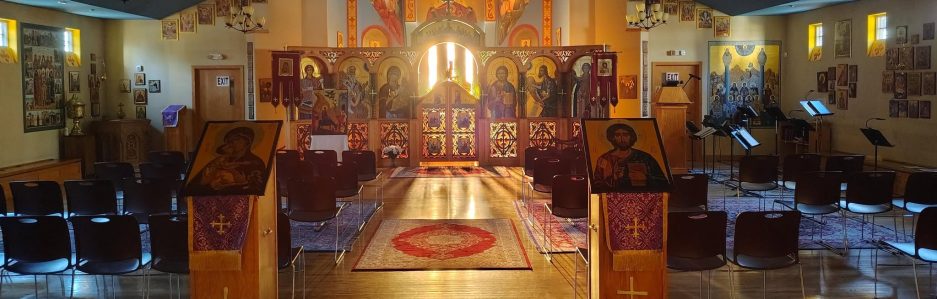
On November 1st, St. Elias Parish calls to mind the life and work of Bishop, now Saint RAPHAEL, the first Orthodox bishop consecrated in America, who served the Russian Orthodox Church and this country by gathering the communities of Middle Eastern immigrants into parishes.
St. RAPHAEL founded St. Elias Church in 1912.
Holy St. RAPHAEL pray for us!


