This…
Life Along the Orthodox Way


 as it travels to the little world that is 4th floor. Slow enough so that people in wheelchairs don’t have the doors slammed on them and slow enough to provide a moment of transition from everything below to everything above.
On the 1st floor are the offices and corporate things. Most everything is beautifully arranged with a view of the gardens and grounds. A post card serenity is there with a background of light Christian music. You imagine your grandmother there. Indeed, you can imagine yourself there some day, a suburban place of rest and relaxation where, after years of work and challenge, you can literally sit on a park bench and watch the lake change with the seasons. It’s that good.
As the elevator proceeds up each floor harder things become more apparent. People who are ill. People for whom the picture postcard of retirement turned into a scrum of illness, deterioration, and a single room with a few possessions and, if you are fortunate, no roommate. 4th floor, at the top, is where this truth of growing old and changing is where that other reality is most real.
Alzheimer’s disease is an illness of the brain. No one is quite sure how you get it and no one knows how to stop it. It kills you, eventually, but not before the person you thought you were gets slowly erased one brain cell at a time until your brain simply tells the rest of you to stop living. Even a cancer has a slim chance but right now there is no chance for the person with Alzheimer’s.
There are times when the very word is fraught with peril. Imagine the mixed emotions to be descendants of Dr. Alzheimer, the person who gave his name to this terrible thing because he began the process of figuring out what it was but also a name that can strike abject terror into the person sitting across from the doctor. If you hear that word, and the diagnosis is true, you will die but not before you change into something you wouldn’t recognize even if you could and the thought of it is a pain worse than any other illness.
The only respite is that eventually you won’t know what’s happening to you. The earliest stages are the toughest because you remain, for a while, aware of the changes, aware there is something terribly wrong happening, and you enter a world where nothing is the same even minute by minute. You can be lost within three feet of where you once stood and the people and places you knew slowly fade out of your comprehension, becoming thoughts you struggle to grasp and words that evade your tongue. As things progress you will lose control of your bowel and bladder and your speech, if it exists, will become gibberish. You may be able to smile but the rest of the world will become a blur where you are moved from place to place and tended to like an infant because, well, you are becoming one. The one good thing, perhaps, is that your death will be quite peaceful, gentle even, as the ravages of the disease give way to a simple falling asleep.
As you ride the elevator from 1st to 4th floor you prepare for this, the people who work as helpers and the families and friends of those who bear this terrible burden. What will I see today? How will this person, or people, I care for be when the door opens and I see them in this place? At best you hope they are at a certain place of comfort and peace. At worst you prepare for what you might need to do when the ravages of this disease turn ugly inside of them. Mostly it’s a little of each.
Some can’t take it at all. Family members who can’t bear the sight slip quietly off the floor never to be seen again until the very end. There’s too much trauma, too much loss, too much heartbreak to bear to look again. That’s understandable. Others are in for the long haul, women, mostly, who come sometimes every day and keep watch as their loved one slips away. Occasionally there is a husband and wife who have taken their vows to this end, a love that refuses to die even in the face of this monstrous thing.
And when you work on this floor, this place where the sometimes forgotten and forgetting have found shelter, you make up your mind to get through this day as best you can. Things will be messy, they always are. Yet, there will also be moments when love breaks through even the horrible reality of Alzheimer’s Disease. There is a quiet confidence that even though the people you care for will forget you and the world will as well (Who, in our cult of youth, wants to remember the suffering and broken?) that God remembers and good, even when it’s never noticed, still has an eternal quality to it.
So the elevator is slow, it has to be, but you press the button for 4th floor and stay the course.

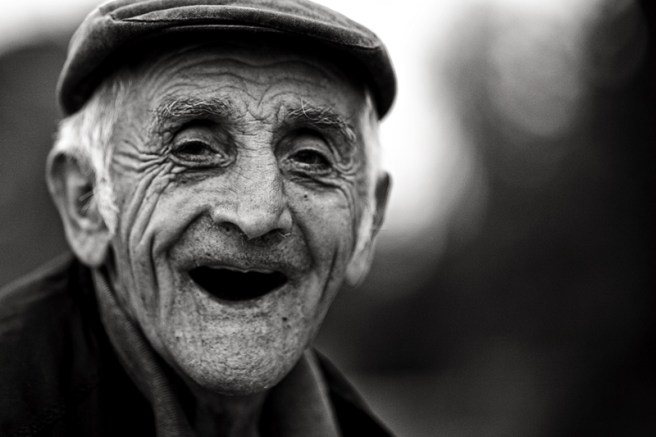
they get to where I work they’ve already been through the system and this is pretty much the end of the line. Wards of the state, their illness, injury, or tragedy has brought them to the nursing home, the last stop in the medical/industrial complex.
Here they will have food, shelter, and medical care until the end. The least we can do, I suppose, for people who were once lovers, friends, workers, leaders, everything that any human being is, and now are laid low by the nature of things. In this place, stripped of most every possession except a room, or half of one, they will pass their days and rage, as the poet says, against the dying of the light.
No one wants to be here, of course, and everyone who is has a trail of loss that led, like bread crumbs on the ground, to this place. Provided by a long ago charity as a way to help the poorest find some dignity in their ending days this place has become the place of choice for world too busy to share the lives of those who have succumbed, as we must all, to the sometimes debilitating end of life. We’ve grown too old for our own good and we’ve added years for the sake of themselves and so we’ve come to this place, a charity for a culture so caught up in its own busy life that it hardly recognizes itself let alone its frail grandparents.
There is a certain sadness here. Those who’ve chosen to serve in these places know that we can never do all that needs to be done and meet every need. There are simply too many of them and too few of us. People who’ve already fallen through the cracks will fall again despite our best intentions. Everyone we throw our own life’s energy into will die no matter what we do. And we will watch it all from the time we clock in until the time we, often exhausted, clock out.
There is also, though, goodness and love here. It’s an imperfect system in an imperfect world but the people who care and have made this system their cause will also fill this place with a kind of love and goodness, both given and received, that only those within can completely understand. It comes mostly in fits and starts, moments in the continuum where a person who has traveled along the medical assembly line finds connection, rest, something to laugh about, or just a dry bottom to make them feel more comfortable. We’re all tired, the people who help and those who need help, but those moments are precious because they’re more real than any wealth and more human than can be possibly imagined.
Jesus is here, too. He just looks like an old man trying to move down the hall in a wheelchair after a stroke. One leg pulls, one arm tries to keep the wheels straight, and Simon of Cyrene is a young woman from Africa who works as a nursing assistant and helps him get where he needs to go. In its own way it’s a place close to God, close for the people who are ending their lives within it’s walls and close for those who serve God in the frailty and even the chaos of those who call this place, for lack of a better word, home.
In the end, it would be a better world if the old could stay with their loved ones for the entire journey and our culture would see that as a value and shape itself around this reality rather than keep the busy busier and discard those who no longer have the strength to make money. Until that time we have these places and the people who try to make the best of a bad situation. While you sleep we’ll keep the light, in all its forms, on and every time we clock on will be a silent witness to what makes us human in the best sense of the word.

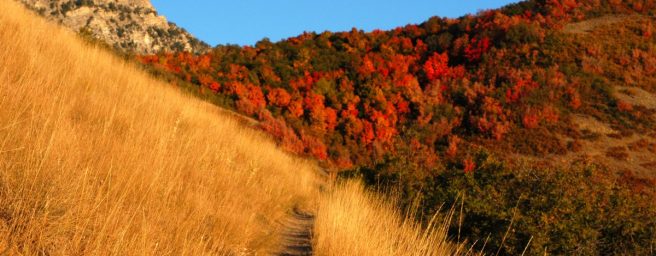
Thoughts wandered while driving though the Minnesota backroads near Welch, a tiniest of settlements formed in 1860 with great hope on the banks of the Cannon river but now mostly a wide, but scenic, spot on the highway. Everywhere around the car autumn was settling in. Colors slightly changing. The sun dipping below the horizon ever earlier in the day. The cool in the air that reminds both man and beast that seasons are in flux.
As the road wound through the hills, thoughts followed the same circuitous route. Memories of a younger man so excited to go to seminary, so wanting to change the world, so sure the future was as wide and high and bright as the skies above a prairie farm. Amazing, the dreams of a young man with a Bible, a seminary degree, and the whole world in front of him.
Time has tempered that. The ideals remain. The hope is there. But as the years behind grow more than the years ahead experience has taught its lessons, sometimes gently and at times with great violence. It’s not that the world doesn’t need some major work. It’s just that great, broad strokes are most often not the way this is done and like it’s the work of ego to think that one person can rule the world it’s also ego to think one person can save it.
I don’t know if it’s wisdom, fatigue, or some combination of them but there’s a craving inside for the mundane, the every day. The young man’s dreams, illusions really, have been through the sausage maker of time and the result is things are both the same and different. Every ideal that spurred the young college graduate to not pursue a career in their field and take the leap to seminary remains but the applications have changed.
The world, in the end, is saved by the mundane, the everyday. Occasionally an apostle of some sort emerges on the face of the earth for a time and a place but for the most part the work of this Kingdom is done every day, a baptism here, a sermon there, a moment to help a struggler, even the seemingly endless meetings are a part of it. And there’s a craving inside for that kind of mundane, a parish, a home, a city, a place and the everyday life that once seemed like so much of a compromise and now seems like something that should have happened a long time ago.
In fact it did, and still is happening, but perhaps it takes a drive through the backroads near Welch to figure it out.



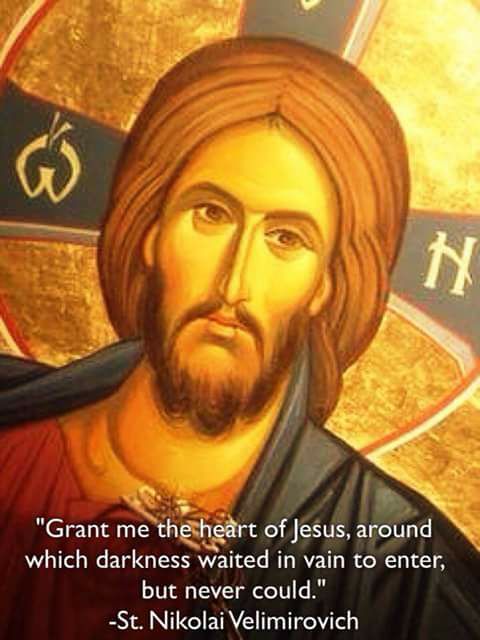
I ask myself is “Do I love God?” I wouldn’t have been able to think of that question myself but over the years, and especially reading the lives of the Saints, I’ve found myself asking the question on more than a few occasions.
I think there were times in my life when I was afraid of God. There were times when I tolerated God. Some times I needed God like an alcoholic needs another drink. If the truth were told there were times when I felt like I didn’t much need God at all. As many possible emotions and states as there could be I suppose I’ve felt that way about God at one time or another.
But do I love God?
For the Saints and holy people of times past one of their qualities was a genuine love for God. They wanted to be in relationship with God. They wanted to be present to God. They valued God’s company and craved Him when they felt He was distant. It was at that point where they went from tolerating God, or honoring God out of fear, or seeing God as some kind of escape from the painful realities of life that they began to love. It was also at that point where they began to be transfigured into something numinous and holy.
So do I love God?
The answer is “I am trying.” I would like to move from lesser relationships with God to love and though there are often fits and starts I would like to think that one day, perhaps, I can return to God a tiny fraction of the love He has for me and for the whole creation. Even the attempt, I suppose, to do this is considered by God to be a kind of love but often it seems so little returned for so much given.
Still, the answer, however feeble it is some times is “Yes”.

In our American context the word “revival” has a special kind of spiritual significance. If you watch Christian television there will always be some kind of “revival” planned or happening or coming and much of it has to do with some kind of charismatic speaker and people becoming emotionally charged as a sign that they are being “revived” by the Holy Spirit.
These moment, more often than not, are temporary and when the shouting and singing are done and people leave the arena very little may have changed. In fact, sometimes people actually wander from place to place seeking out the latest “revival” almost like an addict seeks the next fix. The spiritual life becomes, in a sense, a series of mundane days only broken up by the next big thing and so on and so on.
That’s not really revival, though, because any good speaker can get you to jump up and down but only the Holy Spirit can help you change your life towards Christ in the day to day world that marks most of our existence. It’s actually more of a mark of revival in the Church not so much when people fall on the floor in an emotional outburst as it is when the entire moral tenor of a place is transformed. Real revival means bars have less customers, business people are moved towards ethics, and the people themselves become holy in a deep, profound, and long lasting way.
At it’s core revival is really about a rediscovery of love for God and all the good things that flow from that love. This isn’t love the emotion but love, rather, as an act of the will where the person who loves seeks the genuine good of the other. If we love God our hearts will be drawn that way and our life will be colored and transformed by that love. And when our love tires from time to time because we are human we need to do that which rekindles it in ourselves whether that is our love for a person or for God.
If there is to be true revival in our culture it’s not going to be about emotions per se but rather about a rekindling of something more important, our love for God in response to His love for us. Those caught up in the emotions of a moment are transformed for that moment. Those who are caught up in love for God are transformed for eternity.

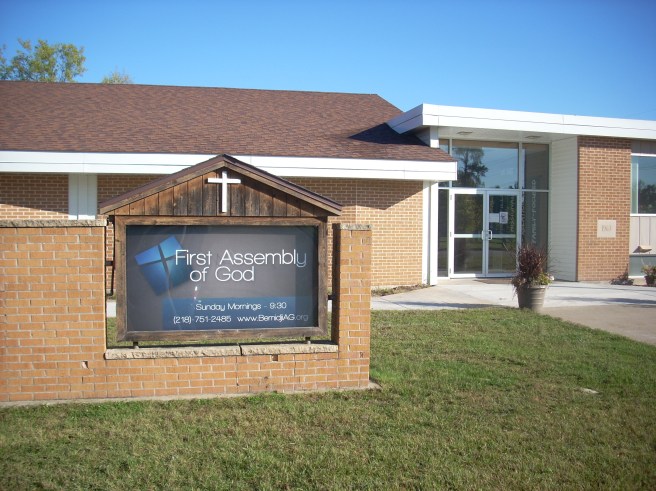
Driving through Bemidji this morning and I wanted to stop here. In college days this was one of the churches many, including myself, attended. We were earnest seekers of God like we were earnest seekers of knowledge and degrees in those days and this was one of the “live” churches in town that also had transportation from campus so those of us, most of us, who were carless had somewhere to go on Sunday mornings (A lesson there for people wanting to reach out to people on campus).
It was led by Pastor Ed Korthals, a middle aged and godly man, who, as I remember, had a good heart and truly loved God. Like many Assembly of God parishes the worship was casual and fervently emotional. The sermons were topical and always drawn from a biblical text. The people were friendly and welcoming (Another lesson there for people seeking to minister to college students) the music was upbeat and sometimes interesting. I do remember people bringing their own instruments, including a kazoo, to church.
Alas, I was probably not the best Pentecostal. I was seeking God and I learned much there but I was not good with all the emotional stimuli. There were times when I felt lost in a sea of people singing in tongues and wondering if I was missing something because I was not with them. I enjoyed the emotional power of people who truly were seeking to love and worship God but I needed a quiet place to do that and that may or not have been the case depending on the Sunday. Yet still I came and this church, because of the love they shared, became a home away from home for me and deeply instructive as I applied for seminary in my senior year.
Little did I know, of course, in those days how far I would have to travel and through how many changes I would need to make before arriving where I am. Over thirty years later and the spiritual journey of a lifetime I found myself, this morning, standing on the lawn of this church and asking God’s blessing on them in thanks for how they helped me along the way at a crucial point in my journey.
If Pastor Korthals is still alive I’m not sure what he would say about the path that I’ve traveled. I hope he would understand that the same earnest young man who came to him with questions and was searching for God has kept on the path, although in a way we both probably couldn’t have imagined. And I hope that he and the good people at First Assembly of God, Bemidji, would know that I was, and am, grateful for the gifts they shared with me along the way. Wherever I have traveled being with them was an essential part of the journey.
You see, some people do look down on what they consider the excesses of the Pentecostal experience and faith. Too emotional, they would say. Too susceptible to “fads” cloaking themselves as moves of the Spirit. Sometimes just plain too noisy. Some or all of that may have some substance from time to time but there are things they taught me that have graced all my life and flowed easily as I traveled towards Orthodoxy and are even, dare I say, worth our consideration.
First, it’s okay to love God, to really love God, even with your emotions. Your emotions are part of who you are and yes, they can be unstable sometimes but they can also be used of God and I don’t think it would hurt us as Orthodox if we loved God not just as a formality but also with a sense of feeling.
Second, we need the power and presence of the Holy Spirit in our own lives and the life of the Church. So often we plan the life of our parishes like a business and forget we are a movement whose goals and methods need to be filled with the reality that the Holy Spirit can accomplish what a purely and perpetually practical outlook would never imagine. We see this, of course, in the lives of our Saints but for the most part I wonder if we’ve forgotten that what we see in the Saints is also for us here and now if we would open our hearts and lives to it. Sometimes we may think the Pentecostals go overboard on this but even if that’s true it doesn’t mean we should throw the baby out with the bath water. Some times we have so little but the reason for that is because our hearts and lives and resources are closed off to the possibility that the Holy Spirit is waiting to do something amazing through us.
Finally, there is a burden for the lost. Yes, First Assembly of God had a lady who would come with a kazoo sometimes but she was welcome and you could have probably come into that church dirty and smelling like booze and still found a place because the people had a heart for those outside their walls who needed to know Jesus. We Orthodox were like that in the very beginning and there have been some noticeable times and places in our history when this was the case but we could do so much better. There’s a reason there’s an Assembly of God in every reasonably sized town, and a few tiny ones, in the United States. The people believe they need to reach out to people for the sake of Jesus and they’re willing to put the time, energy, and resources into the project. If we who claim to have seen the True Light and found the True Faith actually believe this should we not at least try to share this gift? In fact, aren’t we actually commanded by Jesus to do so? We could learn a thing or two, I think, from the Pentecostals in this regard.
Looking back it’s amazing how far God has taken me in the years that followed those days at First Assembly of God. To the causal observer, I suppose, it would seem like I’m a world away. Yet, I’m grateful for that time and that parish and what God was preparing for me through them. Of course much has changed but there was a fire there that the people sought and tried to keep alive, a fire that was Orthodox in it’s source and longing even if it was sometimes distant in it’s application and that fire has remained. It compelled me to go on from that place but, having been molded and shaped in a more ancient way, still burns inside and for that I am eternally grateful.



 The Beautiful Path