
atheists and agnostics actually know the most about major religions and most Americans actually know very little about even the religion they profess.
Category: Faith

If silence wins…
then nothing changes. That which troubles us will remain and become calcified, harder to heal and more resistant to light and grace. It’s not the discussion, the prayers, the confession, the communication, the give and take that will kill us but the silence, the pretending, the hope that we don’t have to look into the darkness within and without.
Silence is the hope that the storms passes somewhere far away. Silence is the desire to avoid the sin without for the sake of the revealing of the sin within. Silence covers the wound before it can heal. Silence shuts the door on forgiveness, change, and redemption. Silence is darkness and death.
Who wishes to be exposed? Who desires to face their sins? Who craves the light that shines in dark corners? No one but the person who finally has nothing left to lose but their soul. Until then, within and without, silence is the enemy of grace, the poison of mortality willingly consumed.
Share this:

A thought…
It’s possible to not love where the Church is at any given moment and still love her for where she has been and where she will eventually be. This is, in part, how she and those who love her have endured.
Share this:

The destination…
1Then I saw a new heaven and a new earth, for the first heaven and the first earth had passed away, and there was no longer any sea. 2I saw the Holy City, the new Jerusalem, coming down out of heaven from God, prepared as a bride beautifully dressed for her husband. 3And I heard a loud voice from the throne saying, “Now the dwelling of God is with men, and he will live with them. They will be his people, and God himself will be with them and be their God. 4He will wipe every tear from their eyes. There will be no more death or mourning or crying or pain, for the old order of things has passed away.”
5He who was seated on the throne said, “I am making everything new!” Then he said, “Write this down, for these words are trustworthy and true.”
Share this:

Why you should go to…
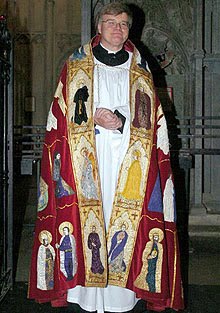
badvestments.blogspot.com (link on the left side) where you can see the world’s first walking iconostasis!
Share this:

A hymn from my childhood…
1 How good is the God we adore,
Our faithful unchangeable Friend:
Whose love is as great as His power,
And knows neither measure nor end!
2 ‘Tis Jesus, the First and the Last,
Whose Spirit shall guide us safe home;
We’ll praise Him for all that is past,
And trust Him for all that’s to come.
Share this:

Yet a little while…
and I believe we will make it through. Because our confidence is not in men but in God. Those who must speak will. Those who must pray will. Those who wait in silence for the storms to blow over will do this as well. Each has the cause of their heart and each will receive their reward.
Our Lord has promised that the Church will withstand the gates of hell but at any place and any time the battle will be more or less. The end, however, is sure. Even if we fail. Even if I fail. Our Lord will not. I must do what I can but my trust, our trust, is higher.
And now on to the day…
Share this:

Why speak out?
Why not just let things be, bide your time, hope that nature takes it course, and keep under the radar? It would, perhaps, be the prudent thing to do. After all, who are you? Nobody really in the larger scheme of things. Why should you think what you have to say is even important? Well the truth is the words may, in fact, be totally unimportant but the saying of them could be.
It took me almost 40 years to find Orthodoxy and enter her embrace. What came before was valuable, important, and Christian but I remember quite clearly being at St. Mary’s Cathedral in Minneapolis, weeping during the Liturgy as the waves of chant flowed over me. I remember, as well, asking the Priest who brought us into the Faith to make sure that if something bad happened to me before our training was done that he would chrismate me before they pulled the tubes. I remember kneeling, the mission we came into Orthodoxy with was Western Rite, and receiving the precious gifts after months without and the joy of arriving home.
Ten years and two ordinations later I still love this Faith. I’ve never grown tired of it. I’ve never lost the feeling of utter awe standing at the altar and my soul has never been at such rest. Its from the love, from that awe, that I try to speak my few clumsy words. Because of what Orthodoxy is, because of what I expect it to be, I want better for it. When there is chaos. When there is pain. When things don’t seem right. There’s a place deep within that feels that passivity is abandonment. I wouldn’t leave my family in turmoil without trying to do something, anything to help. For the same reason I write when I see my Church in its predicaments.
I suppose its always possible that what I write and say could make it worse. Yet if I’m clumsy its the clumsy that comes from loving something so much that I run the risk of overstepping my bounds for the sake of it. I don’t want to see Bishops at discord. I don’t want to see Priest’s in fear. I don’t want to see people who trust us in a place where they are unsure. I hate how I feel sometimes. I hoped for better when I crossed the Church’s door and I’m holding out not just for going along to get along but for that better I believe I was promised, the better that comes with being the Church and the Faith.
Some time ago I saw a bumper sticker that said “Speak, even if your voice shakes” and so I will. I’m no troublemaker, just a person who by God’s grace found the home I sought in this Church, a person who never forgot the joy of it all, and a person who wants it back.
The rest is in God’s hands.
Share this:

Leadership in the Orthodox Church…
comes with authority, not the authority of a group of people who voted 51-49 to make us who we are, but rather the authority that comes with being part of a larger chain of trust and responsibility leading all the way back to the Apostles and Christ.
And as clerics our words matter, our conduct matters. Our calling is an awesome thing in the best sense of the word, worthy of awe and respect but not for its own sake. We forget that sometimes. All the people calling you “Father”, the kissing of the hands, the seat at the head of the banquet, the accolades. It’s all very intoxicating and like all intoxicants it can be very dangerous.
It easy to lose ourselves in the role, to believe our own press releases as it were and get caught up in the fine vestments and privileges of our office. It’s easy when our pictures are on the wall and our name is on the letterhead to lose direction, focus, and purpose. It’s infectious for us all, myself included, and like all infections left untreated it can make us very sick, even kill us.
Because in the end its all about trust. People submit to us, people follow our lead, not because we have a name or title or credentials. Those things may open the door but they mean nothing after the first few impressions. The people we serve, the reason behind the titles and the roles and the vestments, will know whether or not we have their best interest at heart, whether we are a shepherd or a hireling, whether they matter or not. Trust is the currency of authority and when it is squandered its most difficult to recover.
And perhaps the saddest thing in all that has been happening in the Antiochian Archdiocese is that this precious trust, the thing that binds those who lead and those who follow seems to be thrown to the wind for ends still not clear and causes still not certain. At the very moment when those who look to us are trying to find their way perhaps we have forgotten that all that we have been given, our gifts, our authority, is a trust from God a trust the people we serve hope will be used for their increase in holiness, a trust even for those outside the Church, whether they know it or not, that there is light, truth, grace, and holiness to be found in this world.
Does it make a difference who is in charge and how the precious gift of the Church is governed. Yes, it does. Yet, the structure and order of the ancient Faith is not an experiment or an exercise in how best to finesses the system for advantage, rather it is for the care and nourishment of the faithful and so its shape and functions matter. If our concern in all this is pastoral it would be a worthy thing to ask the question “How does our polity best serve the people entrusted to our care?”
Yet how much can we all, all of us who are in some role of authority in this Holy Church, often look like James and John trying to secure the seats next to Jesus in the Kingdom? How often can we forget that the charism is not ours but rather a trust for which we will be called to account? And yes, how often can we forget the people, the ones who kiss our hands and serve us at festivals, the ones to whom, like Christ, our lives are supposed to be dedicated? Have we remembered them in all of this? Have our deliberations, our maneuvers, our opinions, and our actions been designed to bless them, help them, serve them, and increase their faith?
The answer to those questions lie within us, within me, and perhaps the way out of these struggles as well.
Share this:

Another link…
to consider if you are Antiochian Orthodox.

 The Beautiful Path