
Wise Thought…
Life Along the Orthodox Way


There is a hunger among us for something different, something better, something true, real, and good in ourselves and all the institutions of our culture. The desire is almost palpable in the air and the hunger is past the point of pain. Something is wrong and we’re not quite sure what it is. Consider this.
For years in the media, the arts, our schools, our businesses, our religious structures, and the greater culture we’ve been told that morals, truth, righteousness, and all good things are whatever a person decides is appropriate in their own world view. By and large all of us have bought into this in one way or another, lured by the promise of freedom and the possibilities of a soul unlimited by even reasonable constraints. Ancient wisdom formed in the crucible of centuries of human experience has been discarded. We assume that technological progress is the same as the evolution of the human being. We thought we were being progressive and oriented towards a utopian future. Because we can make a better car we came to believe that we were also wiser, more enlightened, and better than the ideas and people who came before us. Yet something is missing.
Slowly we’re discovering that we’ve succeeded in creating, instead of some brave new human, a whole generation plus of self-centered individuals with a fetish for our own desires as civil rights and very little consideration for the world of people outside our own orbit. Our children are becoming little monsters and our politicians remain little children. We believe in nothing beyond the next pleasure and live without a past so we have no future. Our institutions reflect this and are the way they are because they are from us and we are in a very sorry state of things. Now we wonder what has happened and fear for the future.
We don’t need a new political party, a new product, a new corporation, or even a new government. We need a new worldview. And as Orthodox Christians it has to start with Christ and His church, the primal and over arching culture to which we are all supposed to belong.
To do this we will need to see our churches not simply as centers of worship, although true worship is at the heart of things, or places where we socialize or, God forbid, as ethnic centers where we sell goods to outsiders to keep the lights on. We need to see our communities as centers of Christian civilization and culture, bastions of holiness and light. In these places we ourselves will learn, because we often are swept up into our broken culture’s vision, about our Faith as a worldview that impacts every bit of our existence and learn how to practice it and share it with the larger world. In worship we will set our hearts in their proper alignment. In learning we will discover truth that endures. In being community we will help each other along the pilgrim way. The renewal of a culture begins with the revival of the Church. If we want the world to shine with grace and glory we, each of us have to shine, and our churches must be ablaze as well. The world needs examples of the good things we proclaim, proof that there’s some kind of substantial hope. If we are not it then what?
I am convinced that today, somewhere a Saint is being made. Who it may be is not mine to know. God knows. Yet in this world of darkness it will be those transfigured people, Saints in the making, and transfigured churches, where the unconquered Light will shine and through them the world will be renewed. Let it be us.

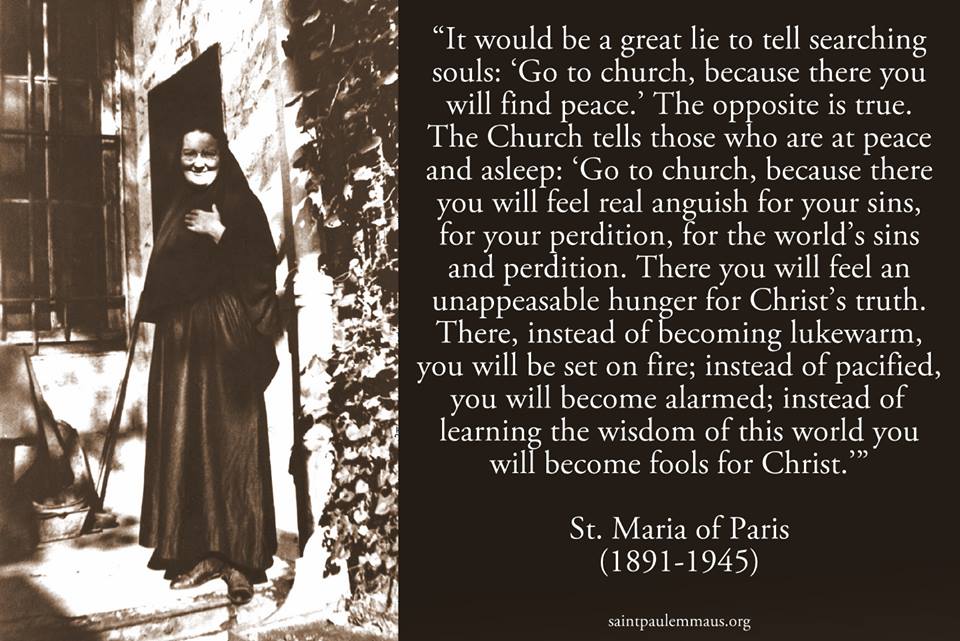

Sadly it happens all the time in coverage of religious or spiritual news. But at least somebody is trying to get the story right. Read the quote and then the rest of the article.
Let’s begin with the fact that the pope has always been “OK” with homosexuals. In fact, by the demands of his own religion he is required to be much more than just “OK.” The Christian faith teaches that every person is endowed by God with an inviolable dignity and therefore deserves our unconditional respect and love.

Wherefore, though good and bad men suffer alike, we must not suppose that there is no difference between the men themselves, because there is no difference in what they both suffer. For even in the likeness of the sufferings, there remains an unlikeness in the sufferers; and though exposed to the same anguish, virtue and vice are not the same thing. For as the same fire causes gold to glow brightly, and chaff to smoke; and under the same flail the straw is beaten small, while the grain is cleansed; and as the lees are not mixed with the oil, though squeezed out of the vat by the same pressure, so the same violence of affliction proves, purges, clarifies the good, but damns, ruins, exterminates the wicked. And thus it is that in the same affliction the wicked detest God and blaspheme, while the good pray and praise. So material a difference does it make, not what ills are suffered, but what kind of man suffers them. For, stirred up with the same movement, mud exhales a horrible stench, and ointment emits a fragrant odor.
St. Augustine of Hippo
via the Holy Fathers Facebook Page

the people on Icons look “weird”…
The way people are depicted in icons is, on the one hand, visibly decipherable as being completely human and like us. Yet on the other hand, iconographic, artistic flair portrays these dead-but-not-dead people in an abstracted, stylized way that proclaims in a poem for the eye that these people are in heaven. For an artist to paint a portrait of someone who is dead-but-not-dead presents a formidable challenge. The answer is revealed as being that “weird” look expressed in Orthodox iconography. –

Among the most steadfast of all the Saints are the virgin martyrs. Their fortitude in the face of extreme persecution humbles us who are often only mildly inconvenienced, at worst, for Christ. Oh, to have this kind of love for Christ and this level of faith. St. Kyriaki pray for us.


…I’ve since learned that planning a truly simple wedding has become practically impossible, unless couples elope or really buck all traditions. Recklessly extravagant weddings have become a cultural expectation. And brides who succumb to the intense pressure to Go Bigger can easily find themselves focused more on planning a wedding than preparing for a marriage.
Read more here.
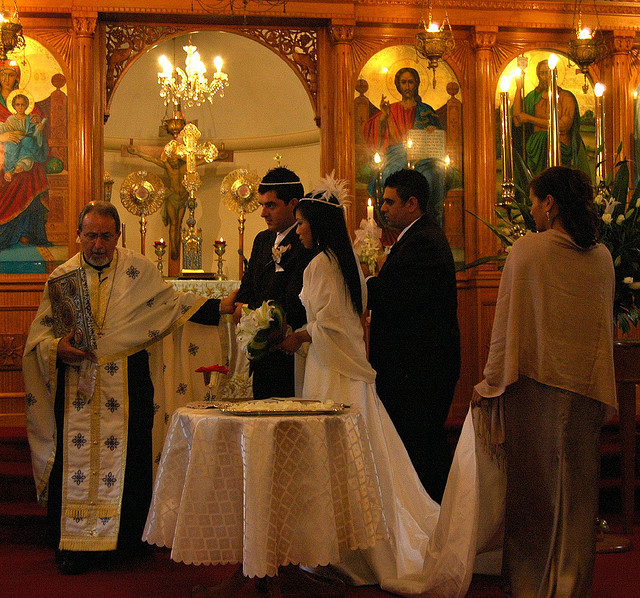
It is possible, easily possible, in the Orthodox Christian context, to have a beautiful and simple wedding. In fact one of the great blessings of Orthodox Christian Faith is that such things, guided by centuries of wisdom and practice, actually are simpler and more beautiful than having to create an “experience” from scratch.

live and share our message without becoming this…
Campaigns designed to raise awareness are as much about advertising the status of the campaigners as they are about changing the outlook of a target audience. For example, advocates of breastfeeding produce literature that affirms the virtuous nature of their own lifestyles while also inviting those who have not seen the light to become aware. The very term ‘raising awareness’ involves drawing a distinction between those who are enlightened, who are aware of something, and those who are not. It draws attention to the fundamental contrast between those who know and those who are ignorant, between the morally superior and the morally inferior. So someone who allows his children to eat junk food is not only unaware and ignorant; he’s also morally questionable.


 The Beautiful Path