Homily, November 23, 2025

Back in the last century when I was a child it would be about this time of year that something would arrive in our mail delivered to us by an exhausted letter carrier. It was a catalog, actual several of them, just in time for Christmas.

Now to you who are not from that century a catalog is really just a thing made out of paper, a book if you will, where, instead of scrolling, you turned the pages and there were pictures and prices of things you could buy. If you wanted something you’d send a check to an address after filling out a form or, perhaps, you’d travel downtown to the actual store and pick it up for yourself. It was a very analog and organic approach to sales and way ahead of its time because it could also be recycled. How cool was that!

And the Christmas catalogs back then were skillfully created to ensure that children would nag their parents day and night for whatever caught their eye in anticipation of the big day. You see the boring stuff like draperies and shoes and housewares were printed in a kind of monotone, not unlike early Windows operating systems, but the potential Christmas presents were printed, at least in my era of the last century, in bright, glossy color that jumped out at our eager little eyes.

Even back then, in the days of only three TV networks, we were already being educated in how to be good members of the consumer society, acquirers of stuff, desirous of whatever was next. And people my age are the ones who raised most of you listening to me right now with what we’d been groomed with ourselves. In our defense we, too, were children of our time and mostly unconscious of the cultural waters in which we swam.

That being said, the catalog people didn’t, however, tell us about the very large downside, the reality that our treasures would break or soon lose our interest or that there would be a later version of our gifts to deliberately render our current ones obsolete. As we grew older they also didn’t tell us that the stuff we thought we wanted to own would start to own us, that bigger, better, faster, and more would require maintenance, upkeep, and a constant chase to stay ahead in the game. They left us blissfully unaware that more stuff means more work and we were definitely never told that everything we thought was ours would one day be someone else’s via the thrift store or eternally slip from our grasp when, one day, our kids would throw it away after our funeral.

They also didn’t tell us that to keep, acquire, and maintain we’d find ourselves making personal compromises. At first they’d be little things but as time wore on the quest for more and the maintenance that would follow would strongly tempt us to cut corners with our family, our politics, our lives, our morals, our faith, and, indeed, our souls.

Threatened with the loss of the things of this world, the pressure to sacrifice our moral core values and the things of eternity can grow, like the rich man in our Gospel, in its allure and what were, at first, little nips around the edges over time can easily turn into large gashes across our souls. Like fish caught up in the moment our vision can easily be blinded to the hook within the easy meal. The fear of losing what we spent so much time and effort to gain and the compromises we found ourselves making to allay that fear are why the Scripture warns us that the love of money is the root of evil but the more we acquire the greater the temptation to ignore the alarm.

Still, there is no evil, per se, in having things. There is, however, great evil afoot if we find ourselves paying for them with our souls. Our Lord knows we have physical and practical needs but if getting them causes us to fall away from being rich in the things of God then we need to ask some hard questions of ourselves. If the compromises we make to keep the temporal start robbing us of the eternal then perhaps this time of fasting is also our wake up call.

Our Orthodox history is full of people who gladly exchanged the whole world, all the things they’d acquired so they could keep their soul. Out stories don’t necessarily have to be exactly like theirs, although they might, but surely the watchfulness they had, the larger vision, the eternal perspective should be ours as well.

On His arrival among us our Lord changed everything and those who accept His story as theirs will see the whole world in a different way. To the faithful Christian what matters no longer comes through catalogs and marketing and the wisdom of this world but rather of that which is, while already present among us, also to come. The eyes that see eternity also see the present in a different way and filter even the good things of this world through God’s lens. And those who choose to keep their soul, especially in a world where the temptation to sell it cheap is pervasive, will find the riches of heaven, the life to come even in the present and become children not just of the times but eternity.

Whatever else happens in this world, my dear Orthodox friends, never sell your soul cheap. Never, ever, ever.

Only Words…

Somewhere along the line we lost the art of dialogue, of rationality, of wisdom and wit, and of speech as a tool for the common good rather than the destruction of our foes. People, even those who we’d normally expect to be better than that, at least in public, have opened the sewers within and decided that the contents are now for public consumption whether we like it or not and there doesn’t seem to be any mother with a bar of soap in hand to take care of it.

“Out of the abundance of the heart the mouth speaks…” (Luke 6:45) and those hearts are being exposed live, every day, on national television. The darkness within has now come out, unashamed, unfiltered, and as obvious as a punch in the nose. Not even the pretense of dignity, nor even the attempt. Just a stream of broken consciousness on display for all to see, a revelation of the deep soulish emptiness disgorged for the public.

This will not be fought with the same fire. It can only be fought with a resolute few deciding to recapture the comeliness of speech and the control of the tongue. The third chapter of James needs to be rediscovered, reinforced, and renewed among the faithful as the precursor of the change we expect in the world. The game only wins if we decide to play it. Opt out and it crumbles, after a few desperate flailing swings at us, under the weight of its crudeness. No need so much for a bar of soap but rather for salt and light and grace and a holy stubborn refusal to ape our superiors who’ve chosen the dark side of the discourse.

In time a simple question will reveal the faithful from the frauds, the good from the bad and the ugly, the moral adults from the children. Do we have to flush after we speak or not?

A Letter to My Parish

As you might know from the news or social media our Orthodox Faith has been in the news across the country. 

The New York Times recently published an article about the “surge” of people, including many young men, who’ve come to the Orthodox Church. The article was generally fair but there have been some who seem to be focused on finding elements of political activism as the major factor in people entering our Faith. This is simply not so. 

A second statement, recently amended, by a Congressman from South Carolina implied that certain elements of our Church in the US are essentially state actors on behalf of the Russian government and claimed that a delegation of American Orthodox leaders, including our own Bishop John, might use their meeting with the current administration to express their concerns regarding the persecution of the canonical Ukrainian Orthodox Church to further Russian political interests. Again, this was met with very direct refutation and the congressman involved has slowly backtracked his claims. 

Things like this should be expected as Orthodoxy begins to draw attention in the larger culture. We’re still a tiny fraction of US Christians, but our rapid growth has drawn attention and a fair amount of it can be speculative and based on a shortage of accurate information or rooted in unexamined stereotypes. People who may know little about Orthodoxy other than what they saw in the movie “My Big, Fat, Greek Wedding” are noticing us, asking questions, and sometimes making assumptions from their own worldviews rather than actually listening to authentically Orthodox leaders and people. 

My encouragement, first, is for all of us to remember that in our current cultural milieu all media has some sort of bias, and we should be careful consumers of it regardless of the source. Ask questions and don’t believe everything you see in print or on your screens as fact in and of itself. Second, and of most importance, is for all of us to faithfully and joyfully live out our Faith and be the embodied truth of what the media can at best see only in shadows. Let our love for God and neighbor worked out in our everyday lives be a living witness so that, as our Lord says, the people around us will see our good works and glorify God. —

Homily, November 16, 2025

Homily November 16, 2025

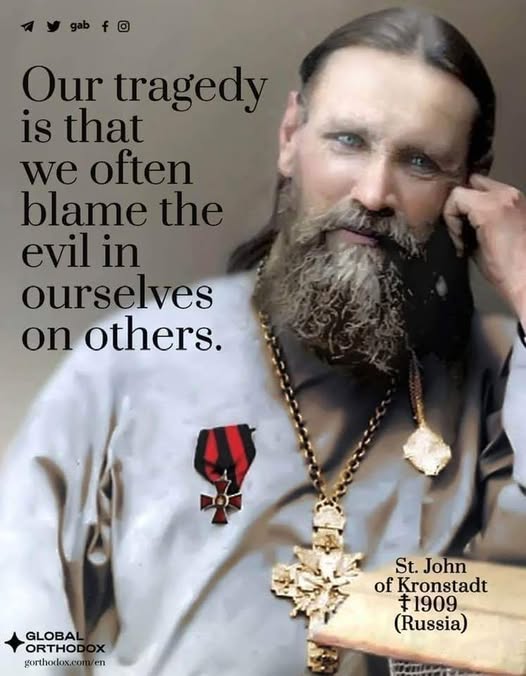
“Do not confuse man -this image of God – with the evil which is in him, because evil is only his accidental misfortune, a sickness, a devil’s dream; but man’s essence – the image of God – is always there”

St. John of Kronstadt

How scandalous Jesus must have appeared in HIs life among us. His followers were largely uneducated. His dinner companions often were tax collectors, prostitutes, and the great unwashed. Wherever He traveled the sick and demonized followed. He touched the untouchables and spoke with great grace to those who had only heard harsh words from their Rabbi 

Our Lord was holy, pure, sinless and, as one of the Trinity, inspired the very laws which many of the people He spent time with had broken. He had every right to judge and yet refrained. He had the ability to point out every flaw hidden deep within the hearts of those who listened to His words but most often chose mercy. The only prayer He had even for those who laughed at His torture on the cross was for their forgiveness. 

Now it wasn’t a matter of low standards or compromise. Indeed our Lord said that the Law must be fulfilled. It also wasn’t about what we call “love” in our times, a bland acceptance of everything, even the dangerous and cruel, rooted in wanting to just get along. There was something more. 

Our Lord Jesus saw that we humans were broken, entrapped, and made mortally ill by our sins. He knew that our decisions often made us playthings of the demonic. He knew our capacity to reason ourselves out of  our situation was compromised. We all had become confused. We were sheep without a shepherd. We had become, as St. John of Kronstadt says, “A devil’s dream.”

And, out of love beyond our imagination and mercy beyond comprehension He came to us in all our various kinds of disfigurement so that we would again be made well, holy, and true. The healthy, or at least those under the delusion of assuming their perfection, never understood this then or now. So the Great Physician came to those who would understand, the sinners of His time, indeed of all time, and chose to be their friend, their companion, and most of all their Savior. And, in doing this He left an example for us all.

One of the great paradoxes of Orthodoxy is that we run hard to get away from the sins which, as the Apostle Paul says “So easily beset us…” Our standards are high and challenging and the goal is to increasingly be nothing less than as like our Lord as possible. Yet that same standard also demands that we see those around us struggling with sin not as lepers to be avoided but as co-strugglers with us caught up in a darkness that we ourselves could easily succumb to if we let our guard down and people who need not a judge but a physician, indeed the Great Physician of our souls.

The temptation is strong, especially in these times, to want to hide ourselves away. A godly life can be very difficult to maintain in a world where things that can do great damage to our souls are not only accepted but celebrated. Yet we dare not if for no other reason than our Lord’s command to “Go ye into all the world…” 

St. John of Kronstadt, quoted at the beginning of this homily, was a man of great personal piety and yet that didn’t prevent him from caring for the hardest cases not with judgement or distance but with compassion and an understanding that each person, no matter what sin encumbered them, bore the image of God and that godly love compelled him to embrace that image even if they had no understanding of it themselves. 

We who’ve been given grace must do the same, never shunning any person regardless of their sins but rather resolving to become channels of God’s grace. To us no sinner is repulsive beyond salvation and any and all who need to repent, like ourselves, are welcome to find among us the salvation we all so desperately need. Those who judge and condemn will accuse themselves by their own standards. Those who graciously hold the high calling of God as a banner and in true Christian love desire to share what God has generously given will both save themselves and become a bridge so those battered by the world can cross to find rest and home with the One whose yoke, unlike this world’s, is easy and whose burden is light.

As Orthodox we work hard to put distance between us and everything sinful and broken within but we don’t put distance between ourselves and the people we encounter everyday who are themselves caught up in the accidental misfortunes and the devil’s dreams. To them we offer mercy, words of life and healing, and with great patience and love share the cup of living water that we’ve been given.

In some ways this is as scandalous today as it was when Jesus walked among us. We live in a world where we’re quick to judge others, forgetting the beam in our own eye while hunting for the specks in others. Yet if the world is to be saved, if we are to be saved, we must both strive for Christ’s holiness and sit, like Him, with the sinners to the end that we and they and all of us may be saved.

On the Packers, Bread, and Circuses

Twice in a row they’ve lost, the Green Bay Packers, and social media is ablaze.

Fire this one! Change that! People who’ve barely or never played the game become sages and definers of excellence. Indeed.

For a bread and circus to work the crowd needs to be placated or the intent will soon lose its power. If my team wins, I win. If the object of my fandom is successful then I am as well and no matter the status of my actual life what happens in the surreal world of the NFL will, perhaps, make up for whatever is lacking.

The lines have blurred. This was deliberate so money could be extracted from the masses by placating them with an illusion of something larger than their humdrum lives. It all depends, however, on winning, on providing that dopamine hit because without it people might go somewhere else, do something else, and not invest in their carefully managed entertainment. Worse yet, they may step outside into the sunshine and fresh air on a Sunday afternoon and discover that life, analog and beautiful, is there to be had with no charge or paywall.

Enjoy the games. I have no problem with that because a little diversion can be a good thing. Understand, though, that it’s not real life but rather a carefully concocted fantasy and that nothing larger than a moment is really at stake and certainly not your emotions. Or your soul. The Super Bowl trophy is gossamer and, in the end, is completely without substance or meaning other than what we give it. A century from now hardly anyone will, or should, care so don’t let it get in the way of having a real life with real people in real time and in the real world.

Or you could just take a ride with your kids on Sunday which, when all is said and done, may do more to better the world than yelling at a screen where no one was ever really listening.

Homily, September 21, 2025

Homily, September 21

As long as we’re children of this world we’ll be slaves. What we’ve given ourselves to will become our master and what we crave of it will become our addiction. Jesus knew this, and thus our Gospel today. 

Because all of it, even the useful things of this world, are temporary. Honors will be forgotten. Riches will end up in another’s hands. Fame will drift from our grasp. Someone else will eventually own your house. And everyone will have their Ecclesiastes moment along the way, a time when they discover, like the wise teacher of old, that everything of this world is “vanity.” 

If all of your hope, if all your life is invested in this world then any disruption will be soul rending and catastrophic not because it truly is but rather because your heart is where your treasure has been placed. Jobs, status, love, beauty, power, wealth all will be revealed as “less than” and exposed as temporary things stored where thieves can steal them and rust and corruption are always a possibility. 

And then there’s death. Roman crucifixions were not just for the condemned but for the public as well, a way to stoke this ultimate fear for the cause of social compliance. Nothing has changed even today. The reality of death has turned us into soulless accumulators and people trapped in the moment.  Our fear of mortality and the baubles it takes from us have often taken us far away from everything that truly matters for the sake of the illusions our world offers as patent medicine for the fear of dying. 

This is why Jesus asks us to take up His cross and, like Him, voluntarily lose the lives we’ve been told are supposed to be in exchange for that which they were truly designed. We were meant to be children of God, of eternity, of a world so much different from that in which we live, a world whose values, meaning, and purpose are filled with the divine and whose citizens are transfigured by the light of heaven. 

To attain this we’re asked to die to everything temporal, mortal, and less. This is a difficult challenge our Lord presents us with. Yet emptying ourselves of these lesser things creates space for everything holy, bright, pure, and eternal.  Remembering this allows us to see beyond any given moment, even episodes of intense suffering, in an awareness that there’s so much greater, more, and holy available even in the face of death. If our Faith is correct you and I will exist eternally so what should we make of any given moment of this fraction of our existence and how should we live differently in the here and now? 

The great St. Polycarp, when threatened with execution by fire, calmly responded by telling the authorities that their short fire would be his deliverance from an eternal one. He wasn’t delusional. He knew what they were planning to do but he was also prepared to take up his cross and give away everything because he saw the larger story behind the immediate, the greater reality beyond the moment, and the eternal life just beyond the earthly horizon. This is the way of all the great martyrs and confessors of our Faith and it can, and should be, God giving us both strength and wisdom, ours as well.

No, we’re not delusional. We need things of this world to live in this world but we do not need to be captivated by them. We know that suffering will visit us. If our Lord was not immune how could we expect to be? Still, we know there’s a bigger reality beyond any given moment, even the painful ones, and even death and loss have been transfigured to the heart willing to become aware of the cross in an eternal and cosmic way.

The rest of the world may see a cross as punishment, as degradation, as meaningless pain followed by empty death. A soul illumined by grace, however, sees in it the death of death, the breaking of the power of sin and mortality, and the glorious freedom of being resurrected to a renewed way of existing in this world, a way filled with the life to come and eternity. 

This is the secret of how we can live and thrive even in a darkened world. This is the basis for how we take holy action in response to the hungers and struggles we see around us and within. This is how we become transfigured rather than degraded by the pain we see around us or the experience of it within. This is how we find life even when it may seem we’re losing all the temporary things our culture tells us to acquire to fill the empty spaces within where God should reside. 

The real question is “Have we had enough?” Have we played the game and grown tired of always falling short of the win? Have we bent and broken ourselves into contortions for things we can’t keep? Have we given precious moments of our life away for that which is carried into the wind seconds after it ends? Have we had a moment when we looked into the mirror and thought “Is this it?”

Perhaps only in that kind of moment when we’ve given up our lives for everything unreal, unholy, and temporal and felt the emptiness of it will we even think of listening to Jesus’ words and consider not clinging so tightly to that which will inevitably pass away while taking up His cross.

And could it be, though, that  when we do we’ll understand that perhaps Jesus was right all along and find, in that truth, the peace and freedom that nothing in this world can take away?

The Gentle Art of Letting Go…

It’s not something you want to do, to say goodbye for now to a long-standing friend, distant family, or an acquaintance over the years. Relationships of value are hard to find and tough to maintain. Yet go, sometimes, they must.

Not all problems are able to be solved. Not all advice is taken. Not all fervent prayers are immediately answered. There’s a point where the puzzle is no longer able to be solved. Sometimes the pathology is too strong. Sometimes, for now, the bad guys win.

This isn’t a trivial thing. People toss each other aside for frothy reasons these days. When the magic is gone, or the utility of the other wanes or age takes its toll. But sometimes it must be done.

Along the way and in a moment of deep pondering, you realize that I, too, will drown if I continue to attempt a rescue and that I’m not immune from burns no matter how much I wish to fight the fires. Where is the “Wonderworking power?” you may think. “Where is my faith?” “Should I not hang on just a little bit longer?” Yet deep in your heart you know that everything that can be done has been done and there is nothing left then to release your grip so you can live to love and care and hope for another day, so you, too, can recover.

Somewhere over the loud screams of guilt there’s a still, small, voice that tells you, even amongst the questions, that your release of the other is not into the void but into the hands of God. God can do what I no longer can. God can accomplish at precisely the point where my own strength has dropped off the charts. I let go of the one I can no longer grasp but in their leaving they may be beyond my weariness but not beyond God’s grace.

And then, into that deep pool of mercy I release the other so that both of us, as we fall into it, can be saved.

Homily, November 10

Homily, November 10, 2024

Who is my neighbor?

The guy ahead of me in traffic watching his phone, drinking coffee, and forgetting his blinker, is, according to Jesus, my neghbor.

The older lady who seems to be taking so much time at the checkout line, she, too, is my neighbor.

The keyboard warrior taking cheap shots at my faith and values from the safety of his room in the anonymous world is to be treatd as a neighbor.

The folks with the rainbow flag on their front porch, they, too are my neghbor and so is the one who struggles to decide what bathroom is best for them.

The young lady leaving the clinic empty of life but full of regret is, by the command of Christ, my neighbor and so is the one who couldn’t care less.

The politician who plucks the heartstrings of my prejudices with their words and the one who’s decided I don’t matter all that much, both are my neighbors.

Some guy on the street with a cardboard sign is my neighbor whether he’s telling the truth about his poverty or not.

The person next to me at church is my neighbor even if we’ve bumped heads a few times at parish meetings.

The one who hurt me long ago is my neighbor whether the pain was deliberate or accidental.

The inmate in jail, even for loathsome crimes, remains my neighbor in the Christian sense of that word.

Even the one who would destroy me if they could is not excluded from the circle of neighbors.

The list goes on and is as wide as the world and near as the person next door. Everyone the Master of the Feast has invited, everyone called out from the highways and byways, strangers, friends, enemies, victims and perpetrators, each, even if they don’t know it, even if they reject it, are neighbor to the truly faithful.  

There are no exceptions, the world according to Jesus, is full of people I need to consider my neighbor and the list is pretty unconditional. The God who sends rain on both the good and the bad, the just and the unjust, calls me to offer, to the best of my ability, everyone I encounter grace, mercy, and yes, even the goodness I would show to a long time and trusted neighbor.

This doesn’t require us to always agree with or accept what others may do or be. We are who we are as Orthodox Christians and the vision of the world given to us in our Faith is wise, time tested, and full of healing grace for those who would embrace it. There are good reasons why we both value and share it even knowing that some may refuse it. 

But the spirit in which we hold our Faith, the spirit with which we encounter the world and the people in it is what makes all the difference. We can become angry, sullen, vindictive, and even play the power games our broken world seems to cherish. We can become hard, insensitive, ungracious and unwilling. We can forget ourselves and seek, even though the Scripture warns us against it, to overcome what we believe to be evil in evil ways. We can objectify and walk past the suffering for a hundred and one reasons bu that is not who our Lord calls us to be.

The Good Samaritan tended to the wounds of the fallen with precisely the medicine and care required. No hesitation in the face of his wounds. No lectures about why the victim was foolish enough to be traveling alone.  No yelling at the Priest and Levite for their failure to serve. Only oil and wine and a place to recover in a sprit of holy generosity and in our world are not such things needed now more than ever?

Jesus teaching here is hard. It’s profoundly counter cultural. To do good deeds for their own sake to everyone who has need is a difficult path to follow. To genuinely love without regard is a narrow path and few find it. It requires the emptying of the self. It requires the suspension of judgment, not to actions, but to the very heart of every person we encounter, everyone our faith teaches us bears the image of God even if it looks like that image has been mutilated beyond repair.

Yet striving to live like this, to live like Jesus, is the very substance of our Faith and contains within it an eternal kind of wisdom. Everything we desire to learn, every discipline we undertake to grow, everything we read and abosorb and struggle with is to designed to help us become something heavenly upon the Earth, light in the darkness, joy among the weeping, and the reality of the world to come in the every day.

And that striving to be neighbor in word and deed to everyone, not in a sloppy or sentimental way but in the pattern set for us by Christ, is what makes us Christian in the best sense of the word. It makes us humble and holy, keenly aware of the brokenness in ourselves and others but also deeply desiring the salvation and healing of everyone, even those we or the world may consider unworthy. It challenges us to die to yourselves but rewards us with the possibility of being resurrected, even in this world, to something so much deeper and better. It settles the heart even in troubled times gives a joy that no circumstance can take away.

Who is my neighbor? If you answer this as Jesus does you’ll change the world but even more you, we, and I will become the children of God.